


Australia’s 3G shutdown rendered many legacy trackers unusable almost overnight. Vodafone went first in December 2023, Telstra switched off in October 2024 and Optus completed its shutdown from 28 October 2024. Some operators didn’t realise their tracking had gone silent until a driver missed a rest break and nobody in the office noticed.
GPS truck tracking covers everything from a $50 personal tracker to a full fleet platform with fatigue workflows, dispatch integration and compliance reporting. The gap between those two things matters more than most operators realise before their first audit. A prime mover crossing 400 kilometres of dead zone on the Nullarbor needs a very different system to a rigid doing 30 stops through western Sydney before end of shift.
TL;DR
How Does GPS Truck Tracking Work?
GPS tracking relies on two systems working together. The GPS receiver picks up satellite signals to calculate position. A separate communication module, either cellular, satellite or both, sends that data back to your platform.
The GPS part works everywhere. Satellites cover every square metre of Australia, from the Hume to the Tanami.
Getting that position data back to you is the hard part.
In metro areas, cellular coverage is strong and data flows in real time.
In remote corridors the story changes. On the Stuart Highway between Alice Springs and Tennant Creek, or through inland NSW on the Barrier Highway west of Nyngan, there are long stretches with zero cellular signal. A basic tracker goes silent through those gaps.
A well specified tracking platform built for Australian conditions handles this differently. Look for devices that store position data locally and upload everything the moment they reconnect. For fleet managers evaluating vehicle GPS tracking across mixed metro and regional operations, offline capability is the feature that earns its keep fastest.
Why Connectivity Is the Real Challenge
Telstra’s 4G network covers around 99% of the Australian population, but that’s measured by residential addresses, not road corridors. In terms of actual landmass, it’s roughly a third of the country. Optus and Vodafone cover less.
If your trucks run linehaul through the Pilbara, central Queensland’s inland corridors or remote stretches of the Barrier Highway or Tanami, cellular alone won’t cut it.
As covered above, every Australian 3G network is now off. Any tracker still running on 3G hardware is a paperweight. We’ve seen fleets blame their provider for “system outages” when the real problem was dead hardware sitting in the cab.
If your trackers went silent in the past 18 months, the 3G shutdown is the most likely cause. Most current commercial trackers run on 4G LTE. Confirm with your provider whether the hardware offers multi carrier SIM support or satellite fallback before committing, especially if you run remote corridors.
Three things separate a system that handles Australian conditions from one that doesn’t:
1
Offline storage and automatic sync: The device logs GPS positions locally when there’s no signal. Once the truck hits a coverage zone, everything uploads automatically. No gaps in your trip history. This is non-negotiable for any operation that leaves metro areas.
2
Multi carrier SIM: Instead of locking to one network, a multi carrier SIM connects across Telstra, Optus and Vodafone depending on signal availability. No single network covers every corridor. Some systems also add satellite fallback for the truly remote stretches.
3
Hardware built for heavy vehicles: Plug in OBD-II trackers work for light vehicles and vans. Prime movers and heavier rigids need a hardwired unit with an external antenna for consistent signal. B-doubles and road trains may need separate tracking on each trailer unit.
If your trucks regularly travel corridors like the Great Northern Highway in WA, inland NSW or mining haul roads, ask your provider how their system handles connectivity gaps. If the answer involves the word “should”, keep looking.
What the Law Says About GPS Tracking
Australian businesses can legally track company owned vehicles, but the rules vary by state and territory. Get this wrong and you risk fines, evidentiary challenges and personal claims under the new privacy tort.
NSW has the strictest requirements under the Workplace Surveillance Act 2005. You must give employees 14 days written notice before tracking starts and every tracked vehicle must display a visible notice.
Non-compliant tracking is unlawful under the Act. Evidence obtained through it may be challenged in Fair Work proceedings. Penalties for relevant offences can reach 50 penalty units, which equates to $5,500 at current NSW rates.
Victoria requires consent under the Surveillance Devices Act 1999 and carries the heaviest penalties in the country: up to $48,842 for individuals or $244,212 for corporations (2025-26 rates). Consent should be documented in writing. Relying on implied consent alone is risky.
If you run the Hume between Melbourne and Sydney, your fleet needs to meet both NSW and Victorian requirements at the same time.
WA, SA and the NT regulate tracking devices through their own Surveillance Devices legislation. Requirements vary between them. The ACT is different again. Workplace GPS tracking in the ACT is governed by the Workplace Privacy Act 2011, which requires written notice and employee consultation before surveillance starts. Queensland and Tasmania have no specific workplace GPS tracking laws, but general privacy and fair work obligations still apply.
Best practice: get documented consent regardless of which state you operate in.
A major change took effect on 10 June 2025. The Privacy and Other Legislation Amendment Act 2024 introduced a statutory tort for serious invasions of privacy.
The key word is “serious”. Tracking company vehicles during work hours with proper notice is very unlikely to meet that threshold. The real exposure sits elsewhere:
Consent is one of several statutory defences. The privacy tort is the biggest change to fleet tracking law in years. GPS data can be relevant evidence in employment disputes, but outcomes are fact specific and depend heavily on whether proper notice was given. Get the process right before you switch the system on.
Best practice across all states:
How GPS Data Supports HVNL Compliance
The HVNL applies in all states and territories except WA and NT, which have their own heavy vehicle laws. A major reform is expected to start mid-2026.
Here’s what’s changing and why it matters for tracking data:
1
Safety Management System becomes mandatory: Operators will need a documented SMS covering hazard identification, risk controls and monitoring. GPS and telematics data becomes core evidence for SMS audit readiness. The new accreditation framework (GSA and ACA) will replace the current NHVAS, with a transition period of up to three years.
2
Fitness for duty expands: The reform broadens requirements beyond fatigue to include illness, injury and substance impairment. GPS data supports the fatigue component by showing driving hours, rest stops and route compliance. It does not cover illness or impairment.
Chain of Responsibility obligations are not new. The 2018 HVNL amendments put a primary duty on every party in the supply chain, from consignors and schedulers to operators. GPS evidence already supports CoR due diligence by showing where vehicles were, how long drivers were on the road and whether rest periods were taken.
NHVR detected nearly 5,000 fatigue offences in 2025. That includes everything from incomplete work diary entries to serious driving hours breaches. For HVNL regulated operations, GPS tracking has shifted from optional to expected evidence in audits. If you don’t have it, you’ll be explaining why.
One important distinction: GPS tracking and Electronic Work Diaries are not the same thing. EWD systems must be specifically approved by the NHVR. A tracking platform with fatigue monitoring features doesn’t count as an approved EWD.
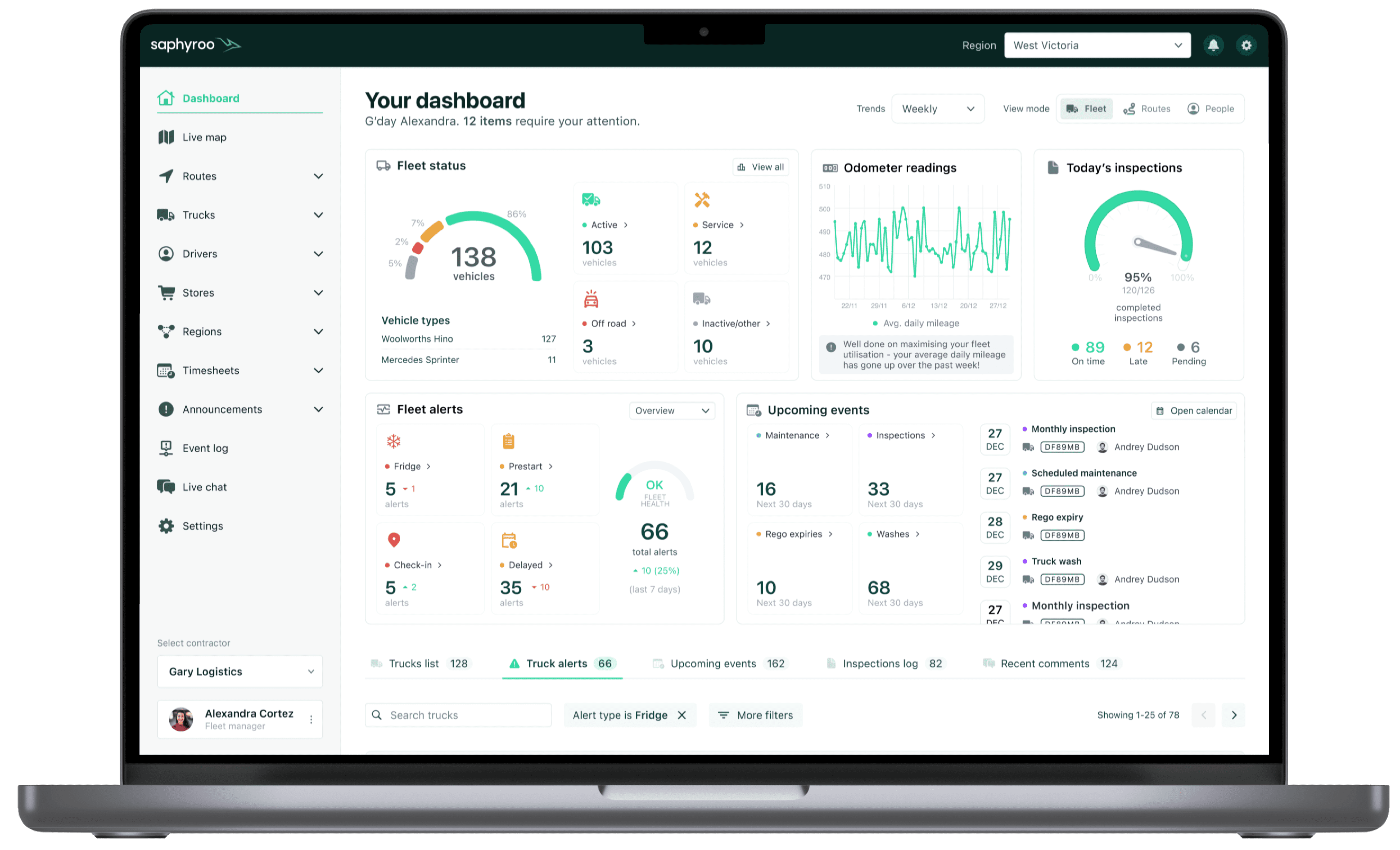
Platforms like Saphyroo connect tracking data to compliance records through fatigue management workflows, but if your operation needs an approved EWD, that’s a separate requirement.
Linehaul vs Last Mile: Different Priorities
Not every fleet tracks trucks for the same reason. What matters depends on whether you’re running linehaul, metro delivery or both.
Fatigue is a priority across both. It’s not just a linehaul problem.
Last mile drivers running long shifts through urban congestion face real fatigue risk, especially during peak periods when schedules get squeezed. Whether your drivers operate under Standard Hours, BFM or AFM, the record keeping and evidence requirements differ at each tier. Tracking data that connects to your fatigue management workflows makes a real difference when NHVR comes knocking.
Linehaul operators running the Hume or the east west run across the Nullarbor care most about fatigue visibility, trip compliance records and idle time at depots. Last mile operators need tight integration between tracking, dispatch and delivery workflows. That means live ETAs pushed to customers, route planning that adapts when jobs change on the road and delivery proof at every stop.
Most Australian fleets aren’t purely one or the other. A refrigerated distributor running linehaul Melbourne to Sydney and last mile drops across the western suburbs needs both offline storage and live dispatch in the same platform. Bolting on a separate tool for each creates data gaps and double handling.
What Features Actually Matter?
Every tracking provider lists dozens of features. Most of them don’t matter.
Here’s what makes a real difference for Australian operations:
Questions to Ask Before Signing
Before you commit, these questions will tell you whether the system fits Australian trucking or was designed for a different market.
Key Questions for Your GPS Tracking Provider
Two more worth checking on pricing and data sovereignty:
Your rigids did 30 stops through western Sydney this morning. Your prime movers are running the Hume tonight. The tracking system needs to work for both.
For most fleets, the strongest business case isn’t the feature list. It’s the insurance premium drop from telematics risk programs. It’s the compliance evidence ready at audit time. And it’s the delivery disputes that stop landing on your desk because you’ve got timestamped proof.
Here’s what to do this week: check whether your tracking hardware is 4G compatible. Audit your notification compliance across every state you operate in. Review your driver tracking policy against the 2025 privacy tort requirements. Then talk to a provider about how their system handles your corridors.
If you need operational control and compliance evidence across your fleet management, start with Drive360. See transparent pricing or book a demo for a walkthrough in your operation.