

One of the most common misconceptions in heavy vehicle compliance is that staying under Gross Combination Mass (GCM) means you’re legal, but this is incorrect. Australian regulators assess compliance axle group by axle group, so a truck can be under its total weight limit and still incur multiple infringement notices if individual axle groups are overloaded.
From 1 August 2026, Australia’s heavy vehicle mass framework changes significantly. General Mass Limits (GML) rise to current CML levels, Concessional Mass Limits (CML) retire and many operators will need to reassess whether NHVAS Mass Management accreditation still delivers value.
At a glance
16.5t – Maximum tandem axle group limit under GML with dual tyres on all axles.
1 August 2026 – Date GML rises to current CML levels and CML retires as a separate scheme.
5% – Maximum CML uplift above GML per axle group.
Up to 3 infringements – A six-axle semi can receive separate infringement notices for the steer, drive and trailer axle groups during one roadside inspection.
20%+ – Overload threshold where court proceedings become routine under HVNL.
HML – Requires NHVAS Mass Management accreditation, suspension certified to VSB 11 and travel on an authorised HML route. NSW operators also need IAP or TMA enrolment.
General Mass Limits: The Australian Axle Weight Chart
The axle group limit is the figure that determines whether an infringement is issued during a roadside inspection.
Gross Combination Mass (GCM) still matters for permits, access conditions and vehicle design, but enforcement officers assess each axle group independently.
The broader NHVR compliance picture covers much more than axle weights, including accreditation, Chain of Responsibility and loading practices. However, when it comes to roadside mass enforcement, axle group limits are the figures that matter most. The chart below summarises the current General Mass Limits (GML) operators use to plan compliant loads and prepare for roadside inspections.
Schedule 1, Part 2 of the Heavy Vehicle (Mass, Dimension and Loading) National Regulation provides a 0.5 tonne complying steer allowance. Vehicles over 15 tonnes GVM fitted with an engine compliant with ADR 80/01 (Euro IV) or later, cabin strength to UN ECE R29 and front underrun protection to UN ECE R93 or ADR 84 may run their single steer axle to 6.5 tonnes. A separate 0.5 tonne uplift on GVM or GCM is then available, but it does not increase the steer axle limit further. Quad axle groups follow their own Quad axle Mass Limits (QML) provisions and those figures change on commencement of the HVNL reform. Check the updated NHVR mass limits guidance once commencement is confirmed.
Why an Axle Breach Bites Before the GCM Does
Three reasons axle group overloads catch operators off guard while GCM looks fine. In most cases, the issue isn’t that the vehicle is too heavy, it’s that the weight is distributed incorrectly.
Uneven load distribution is the most common cause. Loading cargo forward or placing a heavy container on the lead trailer of a B double can push drive axles past their group limit while the total combination mass stays under. The chart above is the test, not the combination total.
Every axle group is assessed separately. A six axle semi operating at the 42.5 tonne General Mass Limit (GML) has three axle groups that a compliance officer will assess: the steer axle, the drive tandem axle group and the trailer tri-axle group. Each must comply with its own legal mass limit, regardless of the vehicle’s total mass.
A Container Weight Declaration (CWD) records the declared mass of a container and forms an important part of the loader’s compliance obligations under the HVNL. (Verified Gross Mass under SOLAS is a separate maritime requirement for export containers leaving the wharf and is not the same document.) If the CWD figure is wrong and the drive axles go over at the weighbridge, the loader’s CoR liability is documented in the CWD itself.
The 1 August 2026 Reset: GML Absorbs CML
Queensland Parliament passed the Heavy Vehicle National Law Amendment Bill 2025 on 18 November 2025. NHVR is targeting a mid 2026 commencement and industry preparation is anchored to 1 August 2026, but the proclamation date remains subject to ministerial approval of the supporting standards.
Two mass specific changes take effect on commencement.
GML rises to current CML levels and CML retires as a separate scheme. Combinations that today require NHVAS Mass Management purely for CML uplift will operate at the same mass under GML without accreditation. That removes the most common reason smaller operators maintained the module.
Mass changes on commencement: GML rises to match current CML levels and CML retires. HML remains a separate accreditation pathway. Operators on CML only accreditation should review whether the module still serves their freight task before the next renewal cycle.
Operators with NHVAS Mass Management renewal due in late 2026 should plan against the new regime rather than today’s CML rationale. Renewing a module whose primary benefit disappears at commencement is a cost with no return.
When CML and HML Accreditation Pays Back
Does the freight task justify the accreditation overhead?
CML lifts each axle group by up to 5 per cent above GML. The total uplift across the whole combination is capped at 1 tonne for combinations with an allowable gross mass not exceeding 55 tonnes and 2 tonnes for combinations above 55 tonnes. NHVAS Mass Management accreditation is required in every case.
CML excludes several categories: buses, truck and pig trailer combinations and class 1 vehicles. If your combination falls into any of those categories, CML is not available regardless of accreditation status.
HML adds requirements on top of NHVAS Mass Management: suspension certified road friendly to Vehicle Standards Bulletin 11, travel under the relevant HML Notice or Class 2 permit on routes authorised for HML access and in some states a telematics condition. In NSW, HML operators must enrol in the Intelligent Access Program (IAP) or the Telematics Monitoring Application (TMA) administered through Transport for NSW and Transport Certification Australia. The uplift to 22.5 tonnes on a dual tyred tri axle matters to bulk operators, but the route network and equipment obligations must stack up first.
Penalties and Who Carries the Risk
Each axle group over the limit is a separate offence assessed at its own risk band. A combination with steer, drive and trailer groups all over can stack three separate infringement notices on the one stop, each at a different dollar value depending on its risk band.
The HVNL structures mass overload penalties by severity band:
1
Minor risk sits at the lowest band, typically up to 5 per cent over the limit, and is an infringement notice rather than a court summons.
2
Substantial risk applies to overloads above 5 per cent and not exceeding 20 per cent. At this band, improvement notices and load restraint reviews become more likely and infringement notices carry higher dollar values than minor risk. Court proceedings are not routine at this level but the financial exposure is meaningfully higher than a minor risk notice.
3
Severe risk covers overloads beyond 20 per cent. This is the band where court proceedings become routine, body corporate penalty maxima escalate steeply and Chain of Responsibility exposure flows across the supply chain.
(Critical risk is a separate band in the HVNL fatigue offences schedule and does not apply to mass overloads.)
HVNL penalty units are indexed annually on 1 August using ABS CPI figures, so the dollar amounts in any printed schedule shift each financial year. Check the NHVR penalties schedule before quoting any specific dollar value in operational communications. A revised schedule will take effect 1 August 2026 alongside the reform.
Mass compliance is a shared responsibility. Under the HVNL, responsibility doesn’t sit with the driver alone. Operators, schedulers, consignors, packers, loaders, loading managers, consignees and unloaders all have Chain of Responsibility (CoR) duties. If an overloaded vehicle is intercepted, liability can extend across the supply chain, not just to the person behind the wheel.
When a vehicle is found overloaded at a roadside checking station, the enforcement officer has several options depending on the severity of the breach. For minor and substantial risk overloads, the officer may issue an infringement notice and allow the vehicle to continue. For severe risk overloads, the vehicle can be directed off the road until the excess mass is removed. In practice, this can mean waiting for another vehicle, transferring freight at the roadside or leaving part of the load behind. The operational disruption often costs far more than the infringement itself.
Mass related infringements don’t just lead to fines. They can affect your insurance and make it harder to demonstrate strong compliance when bidding for work or onboarding with new customers.
Staying Under the Limit: From Pre Load Planning to the Weighbridge
The best time to manage axle weights is before the vehicle is loaded, not after. Planning load distribution first and using a weighbridge to verify it reduces delays, helps avoid roadside infringements and supports your Chain of Responsibility (CoR) obligations.
Pre load mass plan
Load planning starts with the declared mass on the Container Weight Declaration (CWD) or other freight documentation. Before the vehicle is loaded, operators should estimate how the load will be distributed across each axle group so the drive and trailer groups remain within their legal limits. Making adjustments in the yard is quick. Discovering an overloaded axle group at the weighbridge can mean delays, reloading and potential enforcement action.
Verification at the weighbridge
A weighbridge certified legal for trade under the National Measurement Institute is the definitive check. Operator facility scales are useful for pre departure checks but carry less legal standing than the certified commercial sites listed on the NMI register. Roadside heavy vehicle checking stations weigh by axle group and issue infringements on the spot.
On board and portable systems
On board scales give in cab visibility at departure, though most are not legal for trade certification. Portable axle weight pads suit operators running from unmanned depots where a weighbridge is not on site.
Telematics fed mass data
Some integrated fleet telematics platforms surface on board scale data to dispatch dashboards so risky configurations flag before a truck rolls out of the yard. Most Australian linehaul yards still run an in cab driver check at departure as the daily discipline.
The accepted practice for tolerances is to sit 200-300 kg under the limit per axle group. That buffer absorbs scale calibration variation and small loading inconsistencies without putting the combination in breach.
Frequently Asked Questions
Can I be fined for an axle overload if my total GCM is under the limit?
Yes. Axle group limits and GCM are assessed independently. A vehicle under its total mass limit can still receive a separate infringement for every axle group that exceeds its individual limit. Each group is weighed and judged on its own figure.
What’s the difference between GML, CML and HML?
GML is the base limit available to all operators.
CML lifts axle groups by up to 5 per cent above GML. The total combination uplift is capped at 1 tonne for combinations not exceeding 55 tonnes and 2 tonnes for combinations above 55 tonnes, and NHVAS Mass Management accreditation is required.
HML allows larger axle group uplifts but adds suspension certification, authorised routes and (in some states) telematics conditions.
How much weight can a tandem axle carry in Australia?
It depends on tyre configuration. A tandem axle with dual tyres on all axles can carry 16.5 tonnes under GML. Single tyred tandem axles range from 11.0 tonnes (tyres under 375mm) to 14.0 tonnes (tyres over 450mm). CML and HML accreditation can raise these figures further.
Does CML retiring on 1 August 2026 affect existing NHVAS Mass Management accreditation?
Existing accreditation stays valid but what changes is whether operators still need it. Those holding it purely for CML uplift will find the same weights available under GML without accreditation. Operators running HML routes still need the module because HML accreditation pathways continue unchanged after commencement.
Does the axle weight chart apply in WA and the NT?
No. Western Australia and the Northern Territory are not participating jurisdictions under the HVNL. Operators into those states must comply with separate state legislation for mass limits, which may differ from the NHVR axle weight chart figures above. (Check the Main Roads WA website for WA limits and the NT Government transport site for NT limits)
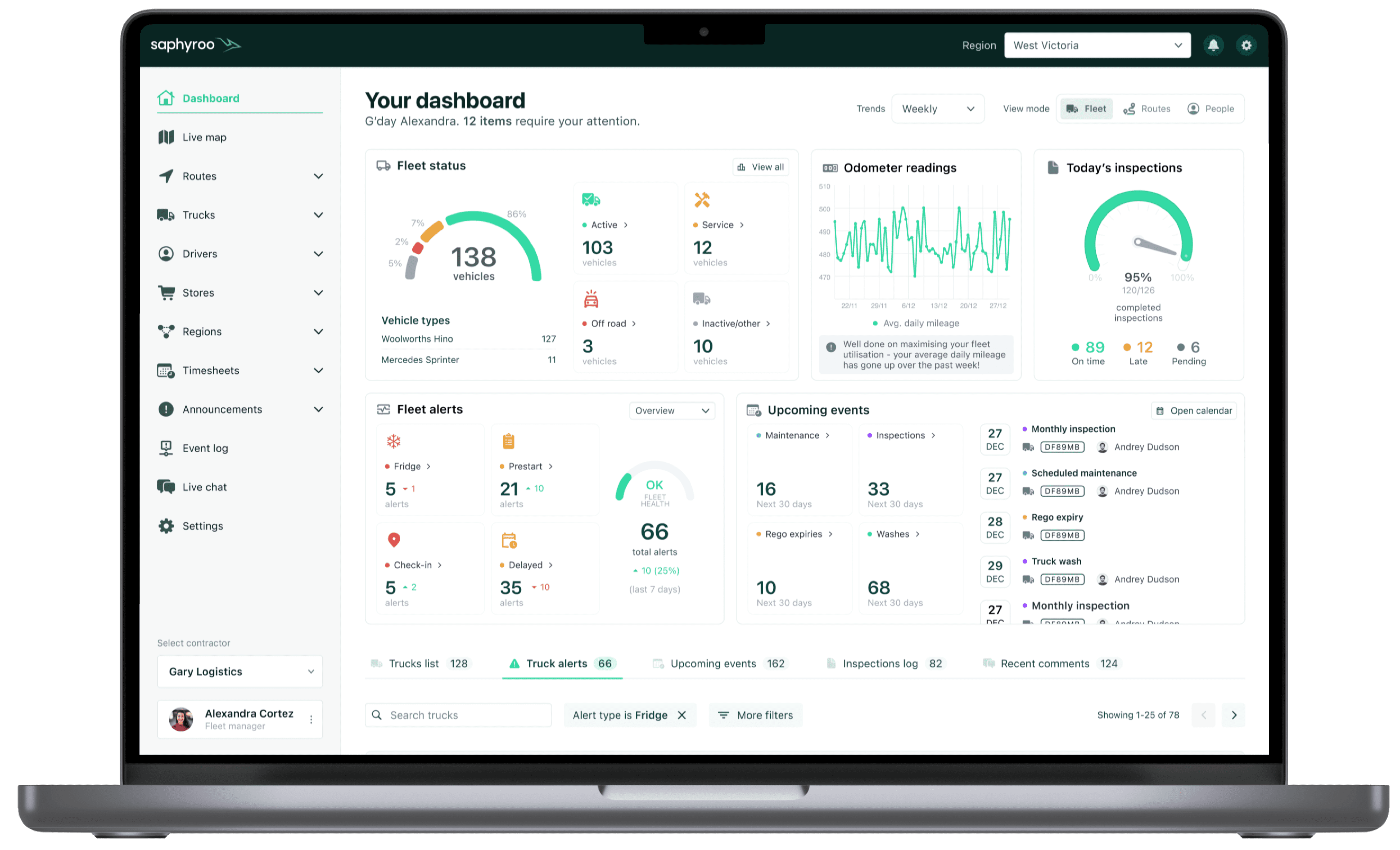
A clear post 1 August readiness sweep is the right move this quarter. Audit which combinations rely on current CML weights, model them at the new GML, brief the loading managers on the loader versus loading manager CoR distinction and check NHVAS renewal dates against the new commercial logic. Where Saphyroo fits is the dispatch layer above all of that, surfacing axle and CoR data to the planner’s screen before the truck leaves the gate.
Final Thoughts
Staying under your Gross Combination Mass (GCM) isn’t enough. Australian heavy vehicle compliance is assessed axle group by axle group, making effective load planning, accurate weighing and strong Chain of Responsibility processes essential. With the 1 August 2026 reforms approaching, now is the time to review your loading practices, reassess your accreditation requirements and ensure your mass management processes are ready for the new framework.
Track Axle Mass Before Dispatch with Saphyroo
Mass compliance starts long before a roadside inspection. Saphyroo gives planners and fleet managers greater visibility over dispatch, compliance and operational data, helping reduce the risk of overloaded axle groups before a vehicle leaves the yard.