

A 20 truck diesel freight fleet operating interstate can claim significant fuel tax credits (FTC) each year. In 2025 – 26, a fleet of this size could potentially recover around $196,000 annually, with higher claim amounts possible for vehicles using refrigeration units powered from the main tank.
While the ATO (Australian Tax Office) updates FTC rates throughout the year, the calculation process becomes much simpler when fleets maintain accurate litre level fuel and operational records.
Eligible credits are generally claimed quarterly through label 7D on the BAS (Business Activity Statement), making accurate record keeping critical for reducing compliance risk and avoiding underclaiming.
Most operators are aware fuel tax credits exist. The challenge is getting the calculation right.
Common mistakes include:
Even small calculation errors can compound over multiple quarterly BAS periods, potentially leading to underclaims, overclaims or compliance issues.
Here’s how to work through it correctly, with the actual ATO rates for 2025 – 26 and a worked example for a 20 truck fleet. All rates in this post are based on the ATO fuel tax credit rates page for 1 July 2025 to 30 June 2026.
What are Fuel Tax Credits?
Every litre of diesel sold in Australia includes fuel excise, a government tax built into the pump price. The fuel tax credit (FTC) scheme lets eligible businesses claim back part or all of that excise through a credit on their BAS, effectively reducing the cost of fuel used in operations.
The fuel tax credit rate depends on how the fuel was used and when it was purchased.
Fuel used in heavy vehicles travelling on public roads receives a lower credit rate because the Road User Charge (RUC) is deducted to help cover road infrastructure costs.
Fuel used off-road or for auxiliary equipment, such as refrigeration units or machinery, can receive a higher credit rate because no RUC applies.
For transport operators, this represents one of the larger recurring cash recoveries in the business. It is claimed quarterly across the year, however a portion is often left unclaimed.
It’s not hidden in the system. Most operators simply underestimate how significantly the auxiliary equipment split affects the final claim.
Fuel Tax Credit Eligibility
Any GST registered business using fuel in eligible activities can claim. For fleet operators, the three main categories are:
Light vehicles under 4.5T GVM travelling on public roads don’t qualify. This includes cars, utes, vans and light commercial vehicles. AdBlue is also excluded, as no excise is paid on it.
If your business operates both heavy and light vehicles, fuel tax credit calculations must be separated for each category. This is where accurate operational records become essential.
By tracking vehicle type, fuel usage and consumption at an asset level, businesses can simplify BAS reporting and avoid manually reconstructing calculations from fuel receipts and records later on.
Current FTC rates for 2025 – 26
As mentioned above, fuel tax credit (FTC) rates are based on the date the fuel was purchased, not the date the BAS is lodged.
The 2025 – 26 financial year includes four separate rate periods due to CPI indexation changes in August 2025 and February 2026, the RUC increase from 1 July 2025 and the three month RUC freeze between 1 April and 30 June 2026.
The table below applies to diesel and other liquid fuels, with all rates shown in cents per litre based on ATO figures.
Here are the rates you need:
Two key points apply to the 2025 – 26 fuel tax credit rates. The on road rate is calculated by subtracting the Road User Charge (RUC) from the full fuel excise rate. For 2025 – 26, the RUC increased to 32.4c per litre, up from 30.5c per litre in 2024 – 25.
From 1 April to 30 June 2026, the Federal Government temporarily reduced fuel excise by 50% and removed the Road User Charge (RUC) as part of a temporary fuel relief measure. During this period, the fuel tax credit rates for heavy vehicles operating on public roads and other eligible business fuel use were aligned at the same rate.
If you are lodging a BAS between April and June 2026, the refrigeration unit (reefer) fuel split may appear to make little difference to the final fuel tax credit calculation. This is because the fuel tax credit rates for on road heavy vehicle use and auxiliary or off-road fuel use were temporarily aligned during this period following the Road User Charge (RUC) adjustment.
However, this was only a temporary measure. Businesses should always check the latest fuel tax credit rates on the ATO website before lodging each BAS to ensure the correct rates are being applied.
Source: ATO, Fuel tax credit rates for business from 1 July 2025 to 30 June 2026.
Different rates apply to LPG, LNG, CNG, B100 and E85. The full table is available on the ATO page above. For 2025 – 26, the on road heavy vehicle rate for all gaseous fuels is nil, as the RUC exceeds the effective excise.
How to Calculate Your Fuel Tax Credit (FTC) Claim
Calculating a fuel tax credit claim is relatively simple, but accurate fuel and operational records are critical to getting the numbers right.
For many fleets, the challenge is not the calculation itself. It’s maintaining clean records that correctly track fuel usage, vehicle activity and applicable claim rates across each reporting period.
Fuel tax credit calculation
The formula
Fuel litresRate (c/L)100Credit ($)
Worked example: Aug to Feb quarter
499,000 L19.2c100$95,808
Repeat across all four rate periods for the full-year claim of about $196,000.
Practical Example: Fuel Tax Credits for a 20 Truck Operation
Fleet profile: 20 diesel prime movers and B doubles, all over 4.5T GVM, operating interstate and regional freight across Queensland, New South Wales and Victoria. Total annual diesel usage: 1,000,000 L per year.
Base case: straight on road freight, no auxiliary equipment.
For a simplified view of the calculation, 499,000 litres at the 19.2c per litre rate (August to February period) equates to $95,808. Applying the same logic across all four rate periods, the total annual fuel tax credit is approximately $196,000. This is claimed in four quarterly instalments through label 7D on the BAS.
With refrigeration: main tank reefers using PCG 2016/11 safe harbour.
ATO Practical Compliance Guideline PCG 2016/11 provides a safe harbour method for refrigeration units powered from the main fuel tank, allowing 10% of total fuel use to be attributed to refrigeration. This portion is claimable at the higher “all other business uses” rate, as it is treated as auxiliary equipment for FTC purposes.
This 10% adjustment increases the annual claim by approximately $24,000 for the same 20 truck fleet, taking the total to around $220,000.
Where refrigeration units operate from a separate dedicated fuel tank, such as trailer mounted reefer units, the fuel used can generally be claimed at the full “all other business uses” rate without the need for apportionment.
The following safe harbour percentages from PCG 2016/11 apply to other common heavy vehicle categories:
Safe harbour percentages are optional and are not the only accepted method for calculating fuel tax credit apportionment.
Businesses can apply any fair and reasonable calculation method, including separate tank measurement or operational fleet data, provided the claim is supported by accurate records and documentation. In some cases, claims above the safe harbour percentages may still be acceptable where sufficient supporting evidence exists. To ensure compliance and accuracy, businesses should seek advice from a transport specialist accountant regarding ATO requirements and eligibility.
For businesses claiming less than $10,000 in fuel tax credits annually, the ATO also provides a simplified calculation method based on fuel spend rather than litres consumed. However, most commercial transport fleets exceed this threshold and complete calculations using litre-based records.
Common FTC Calculation Errors
How fleet data makes FTC claims more accurate
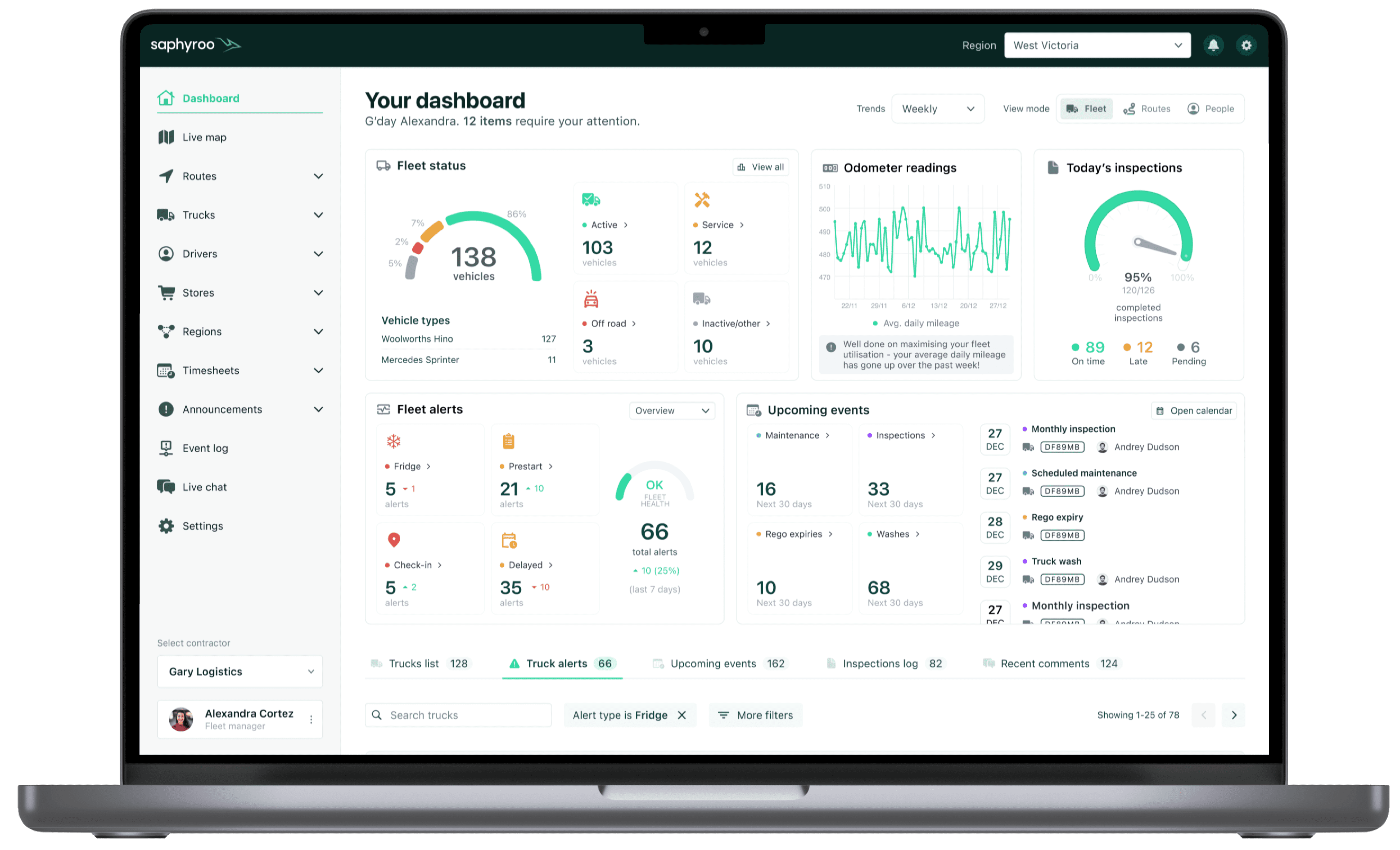
A fleet operations platform already captures odometer readings, trip history and vehicle level fuel usage. If your vehicle tracking captures fuel by asset rather than fleet total, the core data required for fuel tax credit substantiation is already in place.
Building this structure into day to day operations improves accuracy at BAS time and reduces manual reconciliation. The alternative is rebuilding fuel usage from receipts and card statements close to lodgement. That’s where reporting errors typically occur.
How Drive360 Makes FTC Claims More Accurate
The data required to substantiate a strong FTC claim, odometer readings, trip history, fuel usage by asset and vehicle classification, is the same data a fleet operations platform captures as a matter of course.
Drive360 records fuel consumption at the asset level, not just fleet total. Every vehicle’s odometer readings, trip logs and operational hours are captured automatically, creating a continuous record that maps directly to the categories required for FTC calculation: on road heavy vehicle use, auxiliary equipment operation and off road activity.
At BAS time, the calculation starts from clean, litre level data by asset rather than a manual reconstruction from fuel receipts and card statements. This reduces preparation time, reduces the risk of errors from estimation and produces a record trail that holds up under ATO review.
For fleets running mixed vehicle types such as prime movers alongside rigids, reefer units alongside tippers, Drive360 separates fuel data by asset class, so the on road and auxiliary splits are already organised before the quarter closes.
The alternative is rebuilding records from receipts and card statements close to lodgement. That is where calculation errors typically occur and where underclaims go unnoticed for multiple quarters.
Before your next BAS lodgement
FTC rates change in February and August. Before calculating a claim this quarter, confirm the following:
The ATO’s fuel tax credit calculator handles the arithmetic once litres are correctly split by category. For a 20 truck fleet claiming close to $200,000 annually, a last minute spreadsheet will not generally hold up under audit.
Strong fuel tax credit claims rely on accurate records, including odometer readings, trip data, vehicle level fuel usage and fuel card reports showing litres by asset.
Because fuel tax credits are treated as assessable income, large retrospective claims can also impact a business’s profit and loss reporting and overall tax position.
See how Drive360 captures litre-level fuel data by asset so your FTC calculation is already done by BAS time.
This article is editorial guidance, not registered tax advice. FTC rates are based on ATO published figures for 1 July 2025 to 30 June 2026. Confirm current rates at ato.gov.au before lodging.
Where fuel tax credit underclaims have occurred, the ATO generally allows businesses to amend previous BAS lodgements for up to four years. Businesses should consult a transport specialist accountant to help manage the review, calculation and amendment process correctly.