
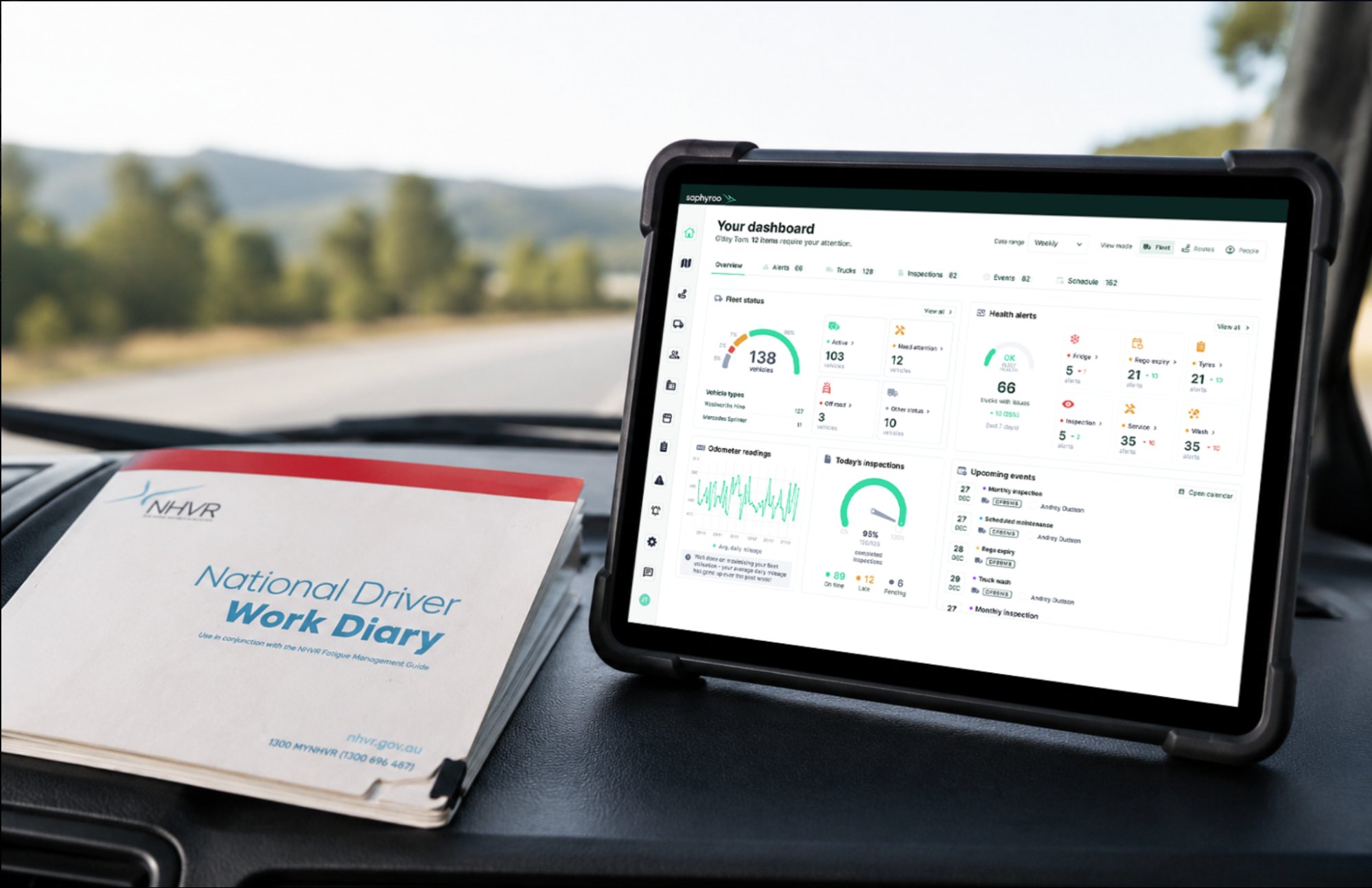


The National Heavy Vehicle Regulator (NHVR) recorded nearly 5,000 fatigue offences in 2025, which works out to roughly 100 drivers each week breaching fatigue and work diary laws.
A work diary records the work and rest hours completed by a heavy vehicle driver. It helps enforce fatigue laws, which are designed to stop drivers spending too long behind the wheel without adequate breaks.
In March 2026, the NHVR launched Operation Ambit, a nationwide enforcement campaign targeting fatigue and work diary breaches across the heavy vehicle industry.
The action followed what the regulator described as “alarming levels of non compliance” among both drivers and operators.
However, in many cases the breaches were found to be unintentional. Drivers often forgot to record locations, left gaps in their work diary entries or mistakenly believed the old 100 km exemption still applied.
Enforcement typically escalates in stages, starting with education and deficiency notices before progressing to infringements and in more serious cases, prosecution.
Even minor work diary breaches can carry substantial penalties. Drivers found operating without a valid work diary may receive immediate fines exceeding $800, while court imposed penalties can surpass $8,000.
Here are the key requirements for an NHVR work diary, who needs one and how to avoid common mistakes that get flagged at roadside intercepts.
What Drivers Need to Know About NHVR Work Diaries
The National Driver Work Diary is the official record of a heavy vehicle driver’s work and rest hours under the Heavy Vehicle National Law (HVNL). It is what enforcement officers check during roadside inspections and what auditors use when reviewing fatigue compliance.
The diary uses a duplicate system, where each entry is copied onto a second page. Drivers complete the top sheet as they record their work and rest hours, while the carbon copy marked “DUPLICATE” is given to the record keeper as the official duplicate record.
The NHVR guidance recommends that duplicate pages be submitted within 21 days of completing them, although the HVNL requires them to be provided as soon as practicable.
Both copies must be kept for three years from the date they are created. They must be stored at the driver’s nominated record location, meaning the agreed address where records are kept and made available to authorised officers on request.
A physical diary costs around $31 from state service centres across Australia. If a diary is lost, stolen or destroyed, NHVR guidance allows drivers to use supplementary records, such as temporary handwritten logs or replacement record sheets, for up to seven business days while arranging a replacement. After those seven days, drivers are expected to have a replacement work diary in the vehicle.
For businesses managing multiple drivers on paper records, replacing lost diaries and handling duplicate paperwork can quickly become time consuming.
When the replacement process regularly affects scheduling or dispatch, centralising fatigue records digitally can become a practical operational decision rather than just a tech upgrade.
Who Needs an NHVR Work Diary
Work diary rules apply to drivers of fatigue regulated heavy vehicles. That means vehicles with a GVM or GCM over 12 tonnes, plus buses with a GVM over 4.5 tonnes that are built to carry more than 12 adults including the driver. If the vehicle is not fatigue regulated, the diary rules do not apply.
For drivers of fatigue regulated vehicles, there are two main situations where a work diary is required.
1
Drivers on standard hours must carry a diary when they travel more than 100 km by road from their nominated base.
2
Drivers on BFM, AFM or exemption hours must carry a diary at all times, no matter the distance travelled. In these cases, every shift is recorded, from the start of the workday to the end.
If a driver has done more than 100 km standard hours work, or any BFM, AFM or exemption work within the previous 28 days, they must still carry a work diary. The diary must also include records covering that work.
Local driving in the current week does not remove the requirement if qualifying work was done in the past four weeks and a work diary may still be required even for short local trips.
Drivers who stay within 100 km of their nominated base on standard hours and have not completed any qualifying work in the previous 28 days are exempt from carrying the diary. But the record keeper still has to maintain local area records for that driver, including: name, licence number, dates worked, vehicle registration, base location and daily work and rest totals.
The exemption removes the requirement to carry a work diary in the cab, but it does not remove the obligation to keep and maintain the underlying records of work and rest hours.
The 100 km radius is measured from the driver’s nominated base under the HVNL, using road distance. If a driver’s nominated base is different from where freight is loaded or dispatched, it is important to confirm which location the 100 km rule applies to before assuming the exemption applies.
Key NHVR Work Diary Exemptions
The National Primary Production Work Diary and Fatigue Record Keeping Exemption Notice 2024 allows drivers transporting primary produce to operate within 160 km of their base without a work diary, as long as they meet the conditions set out in the notice.
The National Heavy Vehicle Emergency Services Work Diary and Record Keeping Exemption Notice 2023 (No. 2) covers certain emergency services operations. These exemptions are not permanent and are updated or reissued from time to time, so drivers should always check the latest version on the NHVR exemptions page before relying on them.
Western Australia and the Northern Territory operate under separate heavy vehicle laws. The Heavy Vehicle National Law (HVNL) does not apply in these jurisdictions, so different fatigue and record keeping rules apply instead.
How to Fill Out an NHVR Work Diary
Every work diary includes instructions in the front pages and drivers should read these before filling anything in. The fields below are where mistakes most often happen.
1
Name, licence number and contact details must be completed on the cover page.
2
The date and starting location (suburb or town) must be recorded for each day of work.
3
Vehicle registration must be entered for every vehicle driven on that day.
4
Odometer readings must be recorded at the start and end of each driving period.
5
A continuous activity record across the full 24-hour window using the three categories: driving (D), other work (W) and rest (R), with no gaps between entries.
6
A location (suburb, town or identifiable place) must be recorded every time activity changes.
7
The signature required at the bottom of each completed page.
One of the most common mistakes is drivers recording driving time correctly but leaving out other tasks such as loading, unloading, pre start checks and similar duties. All of these count as “other work” under the HVNL and must be included in the diary. The time spent at a loading dock still counts as work, not a break.
The rule around continuous recording is strict. Every minute must be accounted for and nothing can be left blank. For example, a 15 minute stop at a roadhouse must be recorded as rest.
Location entries are another common issue during roadside checks. A location must be recorded every time activity changes, using the nearest suburb, town or identifiable place. Terms like “highway” or “M1” are not specific enough.
Drivers who do not record locations in real time will struggle to reconstruct them accurately after a long shift.
Mistakes Often Flagged at Roadside Checks
HVNL penalties are structured in levels depending on the seriousness of the breach. Administrative errors sit at the lower end, while breaches that create a direct safety risk attract the highest penalties.
The figures below are maximum court imposed penalties from the NHVR 2025-26 penalties schedule, which is indexed each year on 1 July to account for updates in penalty units. If a fine is issued on the spot, it is typically around 10 percent of the maximum court penalty.
A few of these issues require closer attention because they carry significantly higher penalties.
False or misleading entries attract the most serious recording penalties for good reason. Under section 325, the offence applies if a driver knew the entry was false or misleading, or reasonably should have known it was incorrect. This second part is important, as it means intent is not required for an offence to apply. If a reasonable driver would have noticed the mistake, it can still be treated as a breach.
Examples include signing a diary before a shift has started, recording rest time that was not actually taken, or logging a location where the vehicle did not stop. These are the types of errors that commonly lead to section 325 prosecutions.
Under Chain of Responsibility rules, responsibility can also extend beyond the driver. In some cases, operators and schedulers may also be held accountable if they contributed to or allowed the inaccurate recording.
Incorrectly assuming the 100 km exemption applies is one of the most common reasons drivers are caught without a compliant work diary at roadside inspections.
Lost or damaged work diaries create additional risk. NHVR guidance allows supplementary records to be used temporarily while a replacement diary is arranged, however operators still need systems in place to ensure work and rest records remain accurate, complete and traceable throughout the process.
After the seven business days allowed for supplementary records, a replacement diary must be kept in the vehicle. The lost work diaries guide covers the process for returning to compliance as quickly as possible.
To understand the scale of enforcement, fatigue offences accounted for over 23% of all breaches detected by the NHVR in 2025. Any incomplete or missing records do not just result in fines. They can also trigger a wider compliance review of the operator’s systems and practices.
For operators managing fatigue records across a fleet, the problem can quickly grow beyond a single missing diary or record. Reviewing paper records for dozens of drivers after an audit notice can take significant time and resources and is rarely something that can be handled quickly.
Understanding Electronic Work Diaries
An electronic work diary (EWD) is a digital system on the NHVR’s approved register that replaces the traditional written work diary. Instead of recording entries by hand, drivers log work and rest activities using a mobile device, tablet or approved app.
The system handles information such as timestamps, GPS locations and activity changes, while also delivering records directly to the record keeper.
One practical advantage of most approved EWDs is that they can warn drivers before they reach a work limit, giving them time to take a rest break before a fatigue breach occurs. How these alerts work can vary between providers and system settings, so it is worth checking exactly what notifications and fatigue warnings are included when comparing different EWD options.
For linehaul operations transporting cold chain or bulk freight over multiple days, having visibility into approaching fatigue limits can make a significant difference.
There are currently 12 NHVR approved EWD providers on the register, including systems from Hubfleet, Logmaster, MTData, Teletrac Navman and Step Global.
Drive360 is currently working through NHVR EWD approval. In the meantime, operators using Drive360 can centralise fatigue records, work diary data and driver compliance across the fleet in one place, reducing the manual work involved in audit preparation and roadside inspection responses.
A recent industry change saw DrivaLink’s NHVR EWD approval cancelled from 1 April 2026. Operators using the platform were required to transition to another NHVR approved EWD provider to maintain compliance.
Since approvals can be granted, suspended or cancelled over time, operators should always check the latest NHVR register before choosing or committing to an EWD provider.
Switching From Paper Diaries to EWDs
Only systems listed on the NHVR EWD register can legally replace a written work diary. Before committing to any provider, operators should confirm the system is currently approved and still listed on the register.
1
When choosing an EWD, it is important to select a system that suits the operation type and route conditions. Operators should also ask specifically about offline recording for regional and remote routes. If the system relies entirely on mobile coverage, missing signals can create gaps in the records, which are one of the main issues officers look for during inspections.
2
Drivers and record keepers should complete the required training before the system goes live. The NHVR provides transition guidance for both roles. It is also important to test the system in real operating conditions before fully replacing paper diaries.
3
Record keeping processes may also need to be updated so audit requests and roadside inspections can be handled quickly through the new system without delays.
The NHVR fatigue risk management guidance explains how EWDs fit into broader fatigue compliance systems, including standard hours, BFM and AFM.
Where to Start
Most of the issues that appear in enforcement reports are administrative rather than deliberate breaches. Common problems include:
One practical way to check compliance is to review a few recently completed diary pages and compare them against the required fields. Missing locations, incomplete timelines or unexplained gaps are the kinds of issues authorised officers commonly identify during roadside inspections.
Identifying and correcting these problems early can help avoid penalties and larger compliance issues later on.