
Managing transport across Australian distances means your carefully built morning plan can unravel within hours. Not because it was poorly planned but because conditions change fast. A driver is delayed on the Brisbane to Sydney run, a Woolworths DC adjusts its delivery window last minute. An urgent same day job comes in and dispatch has to squeeze it in without disrupting the rest of the schedule.
Each of these on its own is manageable. But together, they constantly shift priorities and force decisions in real time. That’s the reality of logistics today, plans don’t stay static for long.
The real question is, can your routes adapt with these changes, or do they start to fall apart?
This is usually the point where operators start exploring transport management solutions. But the term gets used loosely, covering everything from complex, enterprise platforms like SAP to simple GPS tracking tools. To figure out what you actually need, it’s important to cut through that noise and understand what a TMS really does.
What Is a Transport Management System?
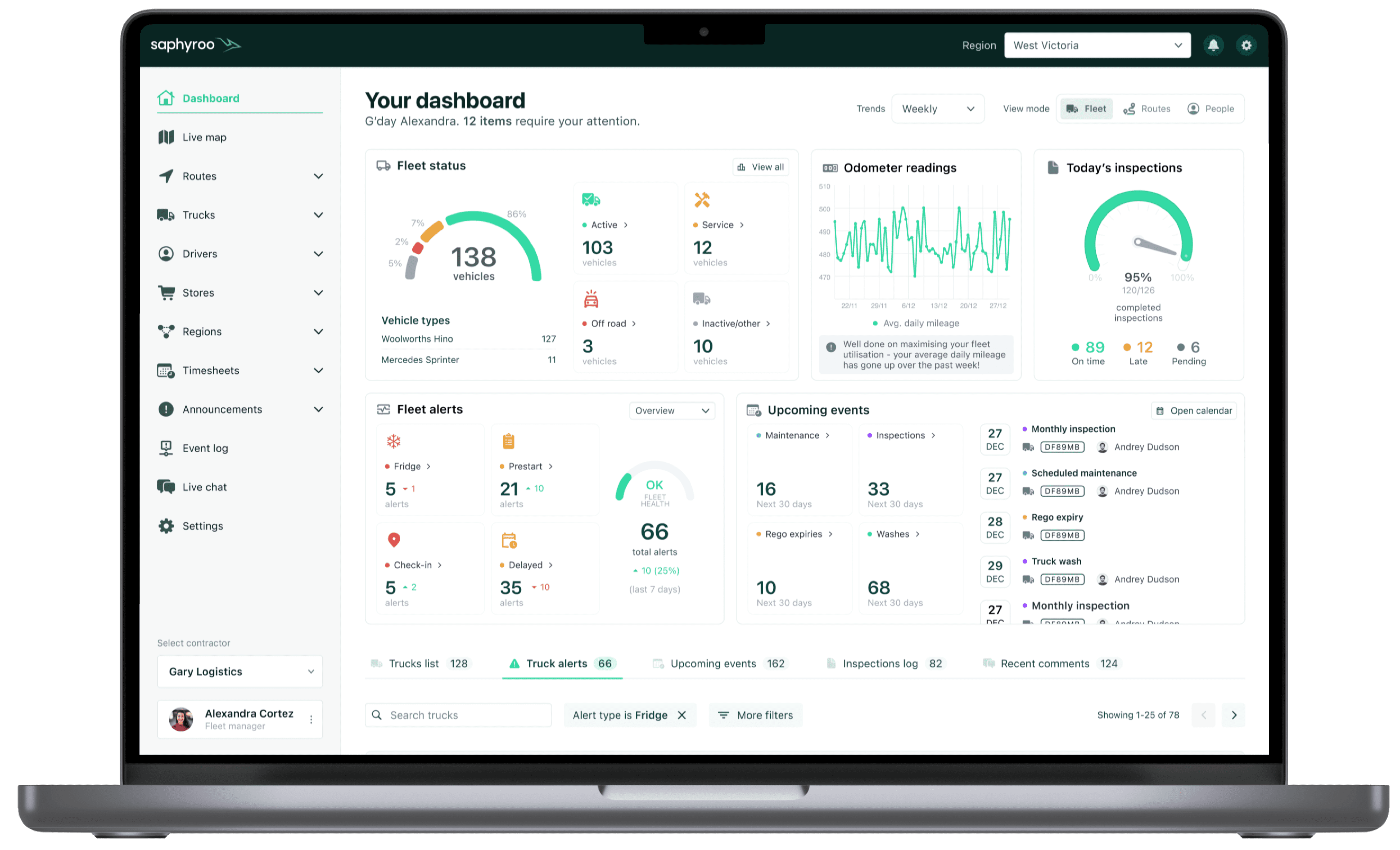
A transport management system is software that centralises the planning, execution and tracking of freight and delivery operations. It brings route planning, real time vehicle visibility, delivery scheduling, carrier management and compliance documentation into a single platform.
The goal is operational control: knowing where your trucks are, whether deliveries are on track and having the evidence trail when something goes wrong.
Think about that Brisbane Sydney driver running late. The delivery window at a Woolworths DC closes at 11am, but he’s not going to make it. Without a TMS, dispatch might not find out until 10:30. Then it becomes a rush, calling the DC, trying to rebook and fixing the rest of the day manually while everything else starts falling behind.
With a TMS, it plays out very differently.
The delay is visible early through live tracking, well before it becomes critical. The system flags the delivery as at risk, giving dispatch time to act. Updated instructions can be sent to the driver immediately, the DC receives a revised ETA and the rest of the run stays intact.
It’s the difference between reacting to problems and staying ahead of them.
That’s what a transport management system does, it doesn’t just plan routes, it manages the whole job from start to finish.
What Does a TMS Actually Include?
This is where a lot of the confusion around TMS comes from.
The term “TMS” is used for very different types of systems.
For example, a large multinational logistics company might use a TMS to manage freight procurement, choosing carriers, managing contracts and handling large scale shipments.
At the same time, a 60-truck food distributor might use a TMS for day to day route planning, deliveries and tracking.
Both are called a TMS, but they do very different jobs.
So when people talk about TMS, it’s important to understand what kind of operation it’s actually built for.
For most Australian fleets, a transport management solution covers these core capabilities:
The TMS and fleet management distinction: A TMS handles freight movement and delivery execution. Fleet management software handles your vehicles, covering inspections, defects, maintenance and asset compliance. Saphyroo covers both. The same platform that plans the run also tracks the vehicle’s defect status before it leaves the depot.
See how Saphyroo handles transport management
TMS vs Fleet Management Software: What’s the Real Difference?
Fleet managers often mix the two up. They’re connected, but they’re designed to do different jobs.
Most Australian transport operations need both, but issues arise when they’re run on separate systems that don’t connect.
Here’s a common example of how this can go wrong.
Dispatch assigns a job to a truck, but that truck has a known brake issue logged in the fleet management system. The problem is, the TMS can’t see that information.
So the vehicle still goes out on the road and if something happens, the records show the business knew about the defect but sent the truck anyway. That creates a serious Chain of Responsibility risk.
The issue isn’t just the defect, it’s that the systems aren’t connected, so critical information gets missed.
Saphyroo’s Drive360 platform combines transport management workflows with fleet and driver management in one system, so dispatch and compliance operate from the same data. The defect that would have been invisible to the TMS gets flagged before the run is assigned.
Why Australian Operations Need Transport Management Solutions in 2026
Australian distances make the operational case for a TMS clear. The Melbourne to Perth run is over 3,400 kilometres, the Sydney basin has hundreds of scheduled delivery windows shifting weekly as retailers adjust dock hours. Major retailers run OTIF (On-Time-In-Full) compliance programs with financial deductions for missed windows, short deliveries or failed proof of delivery. Regional Queensland gets one shot at delivery before a reattempt wipes out the margin on the run.
Manual coordination does not hold up under that kind of pressure.
But 2026 adds a specific compliance dimension worth understanding. Under the Heavy Vehicle National Law, Chain of Responsibility obligations place a primary duty on parties across the supply chain to take all reasonably practicable steps to ensure the safety of transport activities. This is not new. It was established under the 2018 CoR amendments. But the way operators are expected to demonstrate compliance is changing.
The NHVR’s 2026 Master Code has changed how compliance is assessed.
Instead of focusing on set roles and rules, it now looks at the actual risks in your transport operation and how you manage them.
In simple terms, it’s no longer enough to just have policies written down.
Auditors want proof that you’re:
And most importantly they want evidence that this is happening consistently in your daily operations.
A folder full of policies won’t cut it anymore. You need clear records that show those policies are being followed in real situations.
A transport management solution that captures route plans, driver hours, inspection records, delivery evidence and incident data in one platform gives you that audit trail. That’s what the Saphyroo transport management platform is built for: operational control and compliance evidence in the same place, not spread across disconnected spreadsheets and apps.
For a detailed look at how CoR obligations apply to your operation, read Chain of Responsibility Explained.
Signs Your Operation Has Outgrown Manual Coordination
Which Operations Benefit Most from a TMS?
A transport management system (TMS) is most useful when things start getting harder to manage.
That usually happens when three things come together:
When all three are in play, spreadsheets and manual processes start to struggle.
In real terms, this is where most Australian fleets with 15–20+ vehicles sit. At that size, operations are too complex to manage easily without a proper system.
Simple tools work when things are small.
But once your operation gets bigger or more complex, a proper transport management system (TMS) becomes necessary and starts delivering real value quickly.
What to Look for in Transport Management Software for Australian Fleets
Not all TMS platforms are purpose built for Australian conditions. Many are developed for overseas markets and later adapted, with local requirements added as secondary features rather than built in capabilities.
TMS Selection in Australia: Key Checks Before You Commit
A few key gaps to check before you commit:
Route restrictions for heavy vehicles: Make sure the system knows where your trucks are actually allowed to go.
Not all roads are allowed for large trucks.
Fatigue management under the HVNL: Australia has strict driver fatigue rules under the HVNL, which are different from US rules. If the system uses the wrong rules, you could accidentally break the law.
Compliance evidence capture. Under the current CoR framework, operators need to be able to demonstrate they took all required steps to ensure safe transport activities. You need records like:
Your system should store everything in one place so you can prove compliance quickly.
Data hosted in Australia. For operators in regulated industries or those handling sensitive freight, data sovereignty matters. Australia’s Privacy Act 1988 creates obligations around how personal information is stored and transferred. Confirm that customer and operational data is hosted within Australia, not routed through overseas data centres
Integration with your existing stack : Most fleets already rely on tools like telematics, payroll and customer portals. If a TMS requires manual data exports to connect with them, you’re just adding back the admin you were trying to remove. Before committing, check what integrations are available and whether they’re built in or require an extra system to connect everything together. The system should fit into what you already use, not create more work.
These are the questions that separate platforms built for Australian conditions from those adapted later.
Saphyroo’s transport management software is designed with HVNL compliance and local data hosting as core foundations, not afterthoughts.
The Right Scale for Your Operation
You don’t need an enterprise freight platform to fix the problems most Australian fleets face. A 40-truck food distributor has very different needs to a national 3PL managing hundreds of carriers. Getting the scale right matters just as much as choosing the right vendor.
Start with a simple question: what’s costing you the most time or money each week?
For most operators, it comes down to one of four things:
Focus on that problem first. Build your case around it. Choose a platform that solves it well and can grow with you.
Trying to implement everything at once is where most rollouts fail.
If your priority is route efficiency, Saphyroo’s Route Optimisation is built for multi stop Australian operations. If it’s delivery proof and dispute resolution, the Proof of Delivery module brings capture and evidence into one place.
Ready to see how it could work for your fleet?