
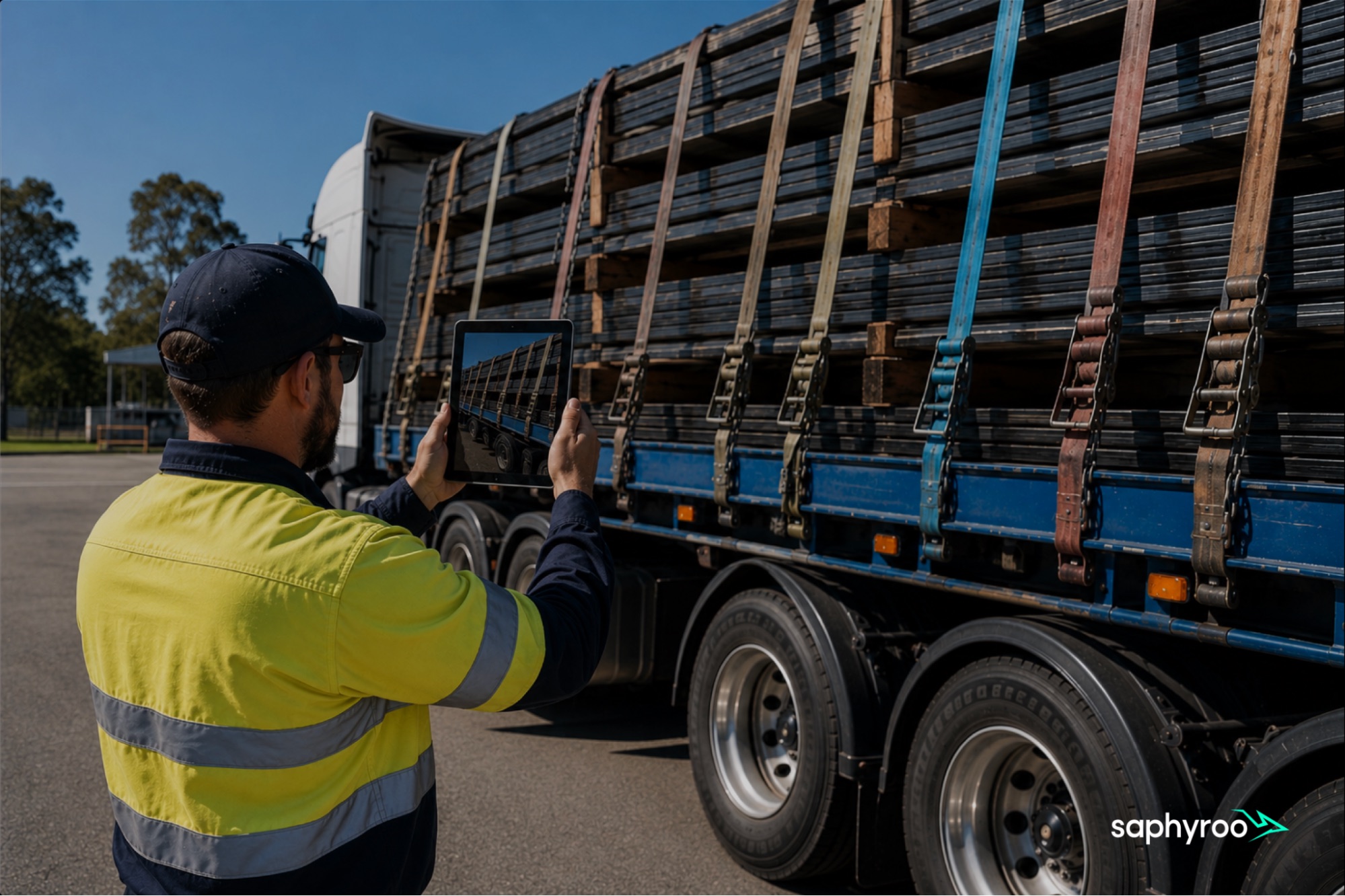


Most load restraint breaches are caused by simple mistakes rather than complex calculations. Loads that appear secure when they leave the depot can still fail a roadside inspection because of incorrectly positioned straps, curtains being treated as load restraint or anchor points without a visible load rating. When that happens, operators often discover that paperwork alone is not enough to demonstrate compliance.
Beyond the rules themselves, this guide covers how load restraint is assessed in practice and the common issues that trigger roadside defects. It also explains why friction often plays a bigger role than operators realise, who may be held accountable under Chain of Responsibility laws and the evidence needed to demonstrate compliance.
At a Glance
What the Rules Require
Effective NHVR compliance begins with understanding that two separate obligations sit at the heart of the Heavy Vehicle National Law.
1) Loading Requirement: A heavy vehicle must be loaded in a way that keeps it stable, prevents the load from falling or shifting and ensures an appropriate restraint system is used. All three conditions apply at the same time, not as alternatives.
2) Performance Standard: This is where many operators fall short. Schedule 7 of the Heavy Vehicle (Mass, Dimension and Loading) National Regulation sets out the performance standards load restraint systems are expected to meet.
The NHVR sets these out in plain terms on its performance standards page. The restraint must prevent the load from moving under 0.8g forwards, 0.5g sideways and rearwards and 0.2g upwards when relying on friction or limited vertical restraint. These are legal minimums, not aspirational targets.
The Heavy Vehicle National Law (HVNL) applies in NSW, Queensland, South Australia, Tasmania, Victoria and the ACT. Western Australia and the Northern Territory operate under their own heavy vehicle laws, so requirements should always be checked when operating in those areas. While the principles are broadly similar, requirements and enforcement can vary.
The current NHVR Load Restraint Guide (Edition 4, June 2025) replaced publication responsibility from the National Transport Commission (NTC). The update mainly improves layout, illustrations and clarity rather than changing technical requirements.
The practical requirements haven’t changed. The 2018 edition updated the language and structure but the performance standard itself remains the same.
The 2004 guide, however, is now outdated and should be replaced with the latest version to ensure policies, procedures and training materials reflect current requirements.
What Counts as a Restraint
The NHVR identifies two basic methods of load restraint: tie down and direct restraint. Most loads are secured using one method or a combination of both, depending on the load type and the forces involved.
Tie down works through friction. Tensioned lashings press the load down onto the deck, creating clamping force. That clamping force increases friction between the load and the deck, which helps resist movement in all horizontal directions. A common mistake is assuming the load’s weight alone is enough. In reality, friction in a tie down system comes from both the weight of the load and the tension applied through the lashings. A heavy load is not automatically a secure one.
Direct restraint works by physically holding the load in place rather than relying mainly on friction. It includes methods such as blocking, containing or attaching the load directly to the vehicle. Examples include chocks positioned on both sides of cylindrical loads to prevent rolling, rated headboards restraining pallet stacks and chains secured between rated anchor points and load rated tie down points. With direct restraint, the load is held by structure and connection rather than pressure and friction.
Curtains on curtain sided vehicles are generally for weather protection only. They do not count as load restraint unless they are specifically rated and certified as such and even then they may only provide restraint in certain directions.
Headboards and front gates only count if they are rated for restraint and supported by manufacturer specifications, whereas side gates are typically not rated for load restraint. As a general rule, a component should only be counted if it is rated for restraint and that rating can be verified.
Equipment ratings must be identifiable and verifiable. A lashing has a rated lashing capacity (LC) and an anchor point has a rated capacity. If the rating cannot be identified, it should not be included in any calculation. Damaged or worn equipment, including frayed webbing, bent hooks or chains beyond service life, cannot be treated as compliant regardless of their original rating.
Friction enhancing materials like rubber mats increase grip between the load and the deck, while dunnage helps space and stabilise the load so it sits more securely. Chocks are used to physically block movement and edge protection prevents lashings from being damaged or losing capacity when they run over sharp edges or coaming rails.
Lashing angle also plays a major role in effectiveness. In tie down systems, a lashing close to 90 degrees to the deck delivers maximum efficiency. As the angle becomes shallower, its effectiveness drops significantly. At around 45 degrees, effectiveness is reduced and at very shallow angles it can fall to a fraction of its rated capacity. This is why a setup that looks secure at a glance can still fail a compliance check.
Assessing Load Restraint
Lashing Capacity (LC) and pre tension are often treated as the same thing, but they measure two very different aspects of load restraint.
LC is the maximum force a lashing is rated to withstand in use. Pre tension is the actual clamping force applied when the lashing is tightened, measured in kgf.
For example, a 50 mm webbing strap with a hand ratchet typically applies around 300 to 600 kgf depending on the tension applied. A 7 mm chain with a turnbuckle can typically achieve around 1,000 kgf of pre tension. A high LC does not automatically mean high pre tension, so both need to be considered when assessing a restraint system.
Improving friction is often one of the simplest ways to increase load restraint performance. In one NHVR example, an 8,000 kg sandstone block is secured on timber using two lashings. Even with the load’s weight and the restraints working together, the setup provides only about 2,800 kg of restraint, which is not enough to keep the load secure.
When high friction rubber matting is placed between the timber and the block, the result changes dramatically. Using the same two lashings at the same angle, the available restraint increases to about 8,600 kg. No additional straps or chains are required. Before adding more restraint equipment, check whether friction can be improved first.
For detailed restraint calculations, refer to the Load Restraint Guide. It provides worked examples for different load types and is the benchmark document used when load restraint is assessed in practice.
Common Load Restraint Mistakes
Who Carries the Risk
Responsibility does not sit with the driver alone and that principle sits at the centre of the Chain of Responsibility framework.
Under the HVNL, each party has a primary duty to ensure safety so far as is reasonably practicable (s26C). That duty is shared across multiple parties at the same time (s26B).
The Chain of Responsibility includes the person who loaded the vehicle, the packer, the loading manager, the operator who authorised the vehicle’s departure and the employer of any of those parties. The driver also has a separate duty under s111, but responsibility does not stop with them. If a load is incorrectly restrained at the depot, liability extends back to those involved in the loading and release process.
Breach classifications under Part 4.4 Division 2 of the HVNL are based on both load movement and the level of safety risk involved.
If a load has shifted or come off, the breach is classified as either substantial or severe, depending on how serious the safety risk is.
If the load has not shifted but is considered likely to, it is classified as either minor or substantial, again based on whether there is an appreciable safety risk.
The “critical” category applies to fatigue offences, not loading, which is a common misunderstanding that can lead to incorrect risk assessment.
The consequences often go beyond fines and can be more disruptive to operations. An authorised officer can immediately direct that a vehicle remain stationary until the load is rectified, on the spot, without waiting for paperwork to be lodged. A defect notice may also be issued.
Repeated non compliance can escalate to prosecution and serious breaches can result in significant court imposed penalties for companies. Because Chain of Responsibility is shared, more than one party can be penalised for the same incident.
Penalty amounts are indexed each 1 July, so the current NHVR schedule should always be checked rather than relying on historical figures.
Building a Load Restraint Audit Trail
Proving due diligence means being able to show a regulator or court that a documented, repeatable process was followed at the point of loading. This means more than saying “we always check”. Evidence is what matters, including timestamps, photos and completed records that show what was checked and when.
The key records include who inspected the load restraint, what criteria they used, when the check was completed, what was found and what action was taken.
A driver signed pre departure checklist meets the baseline requirement, while a loading sign off from a dock supervisor adds an additional layer of Chain of Responsibility coverage where responsibility extends beyond the driver. Photo evidence taken at the point of departure further strengthens the record and helps remove uncertainty if an incident occurs.
Saphyroo’s Drive360 supports this process through digital pre start and inspection checklists that include load restraint checks, photo capture at the point of loading, defect reporting linked through to close out and driver training records.
Centralising restraint records across a fleet replaces paper run sheets with a single evidence base that holds up during inspections and investigations.
Fix the Process, Not Just the Load
Most load restraint failures identified at roadside checks are not the result of complex calculations or engineering. They usually come down to simple issues such as a strap at the wrong angle, a curtain being treated as rated restraint, or a pre departure check that was completed but not documented.
Key Actions for Fleet Operators:
Information last verified June 2026. Editions, performance standards and penalty amounts may change, so always confirm the latest details with the NHVR before relying on them.
FAQs
What are the NHVR load restraint requirements?
The HVNL requires a heavy vehicle to be loaded so its placement does not make the vehicle unsafe or unstable, so the load is not likely to fall or be dislodged and so an appropriate system is used to restrain it.
The legal performance standard requires restraint to withstand 0.8g forwards, 0.5g sideways and rearwards and 0.2g upwards when friction or limited vertical restraint is relied on.
Full guidance and worked examples are provided in the NHVR Load Restraint Guide, which is available to download at no cost.
What is the difference between tie down and direct restraint?
Tie down works by using tensioned lashings to press the load against the deck, creating friction that resists movement. It depends on both the load’s weight and the clamping force from the lashings, not weight alone.
Direct restraint secures the load by blocking, containing or attaching it directly to the vehicle. This can include chocks, rated gates or chains connected to rated anchor points. Most loads use one method or a combination of both.
Who is responsible for load restraint under Chain of Responsibility?
Under the HVNL, multiple parties can hold the primary duty at the same time. This includes the person who loaded the vehicle, the packer, the loading manager, the operator who authorised the vehicle to depart and the employer of any of those parties.
The driver also has a separate duty, but responsibility is shared across the chain. Each party is assessed on whether they took all reasonably practicable steps to ensure the load was safe before the vehicle moved.
Did the 2025 Load Restraint Guide change the rules?
No. Edition 4, published in June 2025, is mainly a formatting and usability update. The NHVR confirms the technical requirements remain unchanged and that the 2018 edition is still compliant.
If you are working from the 2018 guide, you remain within current requirements. The 2004 edition is now significantly out of date in structure and references, so updating to the latest version is recommended as best practice.