

Most operators are treating this as a simple paperwork update, while the regulator is approaching it as a reset in how safety is demonstrated and evidenced.
Since the 2018 Chain of Responsibility (CoR) reforms, the transport industry has operated under a particular compliance framework. The 2026 reforms introduce several major changes that will further reshape operator responsibilities and compliance expectations.
This post breaks down the five key changes operators need to understand, along with five practical steps businesses should start taking now to prepare.
Five HVNL Changes Coming in 2026
Five major changes are coming, with no extra time for a gradual rollout. While many operators still see the changes as a paperwork update, the regulator is treating them as a major change in how fleets show they are operating safely and following the law.
The Heavy Vehicle National Law, administered by the NHVR, applies to every heavy vehicle over 4.5 tonnes gross vehicle mass operating in ACT, NSW, Queensland, South Australia, Tasmania and Victoria.
The HVNL came into effect on 10th February 2014. Western Australia and the Northern Territory have not adopted it and are not part of the 2026 changes. However, vehicles from those states must still follow the HVNL as soon as they enter a participating state.
The Amendment Bill passed Queensland Parliament on 18 November 2025 and was introduced by the Queensland Minister for Transport and Main Roads. Now that the commencement date has been confirmed, here’s what changes when the amended law takes effect.
Mandatory Safety Management Systems
Every operator will be required to have a Safety Management System that meets an approved national standard set by the Minister. That standard is based on five key areas:
During an audit, operators will need to prove that what they say in their policies is actually being done in practice. This includes a signed safety policy from the most senior executive, a risk register linked to transport activities and training records matched to roles.
Operators will also need incident investigation records with completed corrective actions, management review minutes showing executive oversight and a clear document control process with version history. A policy without this supporting evidence will not be enough.
The gap between having a written safety manual and an audit ready Safety Management System needs to be closed ahead of 1 August 2026. This allows time to review your safety manual against the five required outcomes and address key gaps, particularly in the risk register and management review process.
This should also be enough time to secure executive sign off and complete at least one full cycle of evidence, such as a toolbox talk, an incident review and a closed corrective action. That cycle is what an early audit will focus on.
New Heavy Vehicle Accreditation Scheme
The SMS requirement applies to all operators from 1 August, whether they are accredited or not. General Safety Accreditation (GSA) is the way operators have their SMS independently audited and recorded on the HVA register. Choosing not to become accredited does not remove the SMS obligation.
The new HVA scheme replaces the current National Heavy Vehicle Accreditation Scheme (NHVAS). It is structured in tiers to reflect different levels of assurance and compliance.
General Safety Accreditation (GSA) is the entry level accreditation. It requires a third party audit against the SMS Standard. While GSA on its own does not provide regulatory concessions, it is the foundation for higher levels of accreditation and can support tender and prequalification requirements.
Alternative Compliance Accreditation (ACA) builds on GSA and adds additional requirements depending on the type of operation. It is available across Mass, Fatigue and Maintenance streams, with scope defined by the NHVR.
NHVAS will stop accepting new applications once the amended law comes into effect. Existing NHVAS operators can continue under their current accreditation for up to three years.
However, the key transition point is renewal: from commencement, all renewal applications will move into the HVA system and be assessed against the new SMS standard. This means operators with renewals in late 2026 or 2027 will need to transition much sooner than the three year window suggests.
Full detail on the transition is on the NHVR HVA Operator FAQs page.
Alternative Compliance Hours
The current NHVAS fatigue modules, BFM and AFM, are being phased out and replaced under the new HVA framework with a single fatigue option known as Alternative Compliance Hours.
This new model will use set templates for work and rest hours. These templates are still being finalised as part of the Ministerially approved Standards. Once published, existing BFM hour structures will be matched to specific templates, while AFM arrangements will be translated into the same system. Operators currently running BFM or AFM will not lose their existing fatigue management work, but it will need to be restructured to align with the new templates once they are released. For now, the key task is keeping rosters, exemptions and fatigue management plans in a form that can be easily mapped across.
The electronic work diary (EWD) will replace the paper based National Driver Work Diary as the digital option for recording work and rest hours. Only NHVR approved devices can be used as compliant Electronic Work Diaries (EWDs) and systems already approved will continue operating under the updated laws without needing further approval.
Platforms supporting Electronic Work Diary (EWD) workflows are designed to work alongside approved EWD devices, not replace them.
Saphyroo currently supports the broader fatigue compliance process through operational visibility, fatigue records and compliance evidence management, while also progressing through the NHVR approval process for its EWD platform.
Mass and Dimension Reform
General Mass Limits (GML) will increase to match current Concessional Mass Limits (CML) and once they are aligned, CML will be phased out. This means operators will no longer need accreditation to access what are currently CML weight settings.
For a prime mover and single semi trailer operating under general access, the maximum length will increase from 19 metres to 20 metres. The length limits for B-doubles, B-triples and road trains remain unchanged under this reform. Euro VI mass concessions, which are currently available to compliant prime movers and rigid trucks, will also be extended to road trains.
For many operators, this additional metre may allow for one extra pallet position per load. For those currently paying for CML accreditation, that requirement will be removed from 1 August. However, operators running Higher Mass Limits (HML) under PBS or specific permits are not affected in the same way and their existing conditions will continue to apply. Operators should confirm their individual requirements with NHVR before making any changes to existing accreditation.
Unfit to Drive Duty
Drivers must not drive if they are unfit for any reason, including illness, injury, drugs or alcohol or fatigue. The Unfit to Drive duty sits alongside the existing Chain of Responsibility Primary Duty on operators and schedulers. The principle itself is not new, but what is changing is that a driver’s fitness for duty will now need to be formally recorded as part of compliance, rather than managed informally.
If there is no documented process showing a driver was fit to work on a given day, it creates an evidence gap. In the event of a fatigue related incident, investigators will first look for this record within the Safety Management System audit trail, before considering whether executive due diligence obligations under section 26D have been met.
Chain of Responsibility in HVNL 2026
The 2026 changes build on a duty framework that has been in place since 2018. The Primary Duty is the foundation and the Safety Management System (SMS) becomes the way operators prove they are meeting it.
Under Section 26C of the HVNL, every party within the Chain of Responsibility has had a legal obligation since 1 October 2018 to ensure the safety of transport activities, so far as is reasonably practicable.
The NHVR refers to this as the “Primary Duty” obligation.
Importantly, this is not something introduced under the 2026 reforms as it has already been part of the HVNL framework for years.
Section 26D adds responsibilities for company executives and directors. It means senior decision makers can be held personally responsible if the business does not properly manage transport safety risks. These obligations cannot simply be handed off to another team or manager. For example, if a director leaves fatigue management entirely to the operations team and that system later fails, the director may still be personally accountable.
Ten different parties have responsibilities under the Chain of Responsibility laws. These duties extend beyond operators and prime contractors to include schedulers, consignors, packers, loaders and unloaders.
Drivers also have responsibilities under the HVNL, but they are not considered Chain of Responsibility parties unless they perform one of the listed roles. Owner drivers are different because they operate as both the driver and the operator, meaning they carry responsibilities in both areas.
Schedulers and consignors also carry responsibility under the Chain of Responsibility laws. If delivery timeframes or loading schedules are unrealistic and push drivers to exceed work and rest limits, responsibility does not sit with the driver alone. The party that created or imposed those schedules may also be held accountable.
Under the amended HVNL, SMS records are likely to be the first thing reviewed during an audit or Chain of Responsibility investigation. Without clear records and supporting evidence, operators may struggle to show they were meeting their compliance and safety obligations.
The Regulatory Framework Behind the Changes
Five regulations sit underneath the HVNL framework. Two of them are changing from 1 August 2026, while the other three continue to set the day to day operating rules for heavy vehicle compliance.
Fatigue Management National Regulation
This regulation sets the legal work and rest limits for fatigue regulated drivers. The National Driver Work Diary is used to record driver work and rest hours.
Standard Hours remains the default framework, while BFM and AFM are the current accreditation options allowing approved operators to work under alternative fatigue arrangements.
From 1 August, BFM and AFM will be replaced by Alternative Compliance Hours under the new HVA scheme. The fatigue rules themselves are not being replaced, but the accreditation system supporting them is changing.
Keeping fatigue records organised and ready for audit is the key practical requirement here. Fatigue management workflows that link driver hours to a clear compliance record will become more important on 1 August than they are today.
Mass, Dimension and Loading National Regulation
This regulation covers axle limits, gross vehicle mass, gross combination mass and how loads must be restrained.
The 1 August changes sit within this framework and include:
If your fleet currently operates close to existing mass limits, it is worth checking your vehicle combinations against the new GML settings before the changes take effect.
Vehicle Standards, Registration and General Regulations
These three areas are often treated as background rules, but they directly shape how enforcement happens under the HVNL.
Vehicle Standards cover roadworthiness, defect notices and maintenance requirements. For example, an unresolved minor defect notice can be escalated to a major defect notice or even a prohibition notice, which can take a vehicle off the road until it is repaired and reinspected.
Registration is managed by each state, but it still operates within the national HVNL framework.
The General Regulation sets out how enforcement works in practice, including infringement processes, the powers of authorised officers and the procedures used during roadside inspections and compliance checks.
HVNL Penalties and How Enforcement Works
Under the HVNL, there are two main types of offences: infringeable offences and court imposed offences.
Infringeable offences can be paid or challenged in court. The NHVR states that “the payment level for infringeable offences in the HVNL is 10% of the maximum court imposable penalty.”
Penalty amounts also change over time. The NHVR explains that the HVNL includes an indexation system that uses Australian Bureau of Statistics data to update maximum penalties. These updates occur on 1 July each year. Because of this, any training material that relies on fixed dollar figures quickly becomes outdated. Figures from 2024 are already out of date and will change again from 1 July 2026.
Check the current NHVR penalties schedule before using any specific figure in communications.
Executive exposure under section 26D is different. Breaches of the executive due diligence duty are court imposed offences and apply personally to individual executives, not just the business. This means directors and owners can be held personally responsible, regardless of company structure.
Most enforcement action does not start in court. Authorised officers typically issue improvement notices, which give a set time to fix an issue. They may also issue prohibition notices, which stop a vehicle, driver or activity until the problem is fixed, as well as defect notices or formal warnings.
If an improvement notice is not acted on, it can escalate to stronger enforcement action, including prohibition or court proceedings. A prohibition notice issued at the roadside can immediately take a vehicle out of service.
What to Do in the Coming Weeks
With the 2026 HVNL changes approaching and no broad transition period announced, operators now have a short window to prepare. The coming weeks should be focused on reviewing current systems, identifying compliance gaps and making sure the business is ready before the new requirements take effect. Here are the practical steps operators can start working through with their teams today.
1
Start by reviewing your current SMS against the five required outcomes: Leadership and Commitment, Risk Management, People, Assurance, Monitoring and Improvement and Safety Systems. Work through your safety manual section by section and identify what is missing, outdated or unsupported by evidence. That gap list becomes the practical work plan for the next few weeks.
2
Decide which HVA pathway fits your operation. Operators without current NHVAS accreditation may only need GSA. Operators currently using Mass, Fatigue or Maintenance modules and wanting to retain equivalent concessions under the new system will likely need GSA plus ACA for those areas. Audit preparation should match the activities your business is actually running today.
3
If your business currently operates under BFM or AFM, begin reviewing how your work and rest arrangements will fit into the new Alternative Compliance Hours model. Existing fatigue risk assessments remain useful, but they will need to be documented under the new framework once the templates are released. For fatigue accredited operators, this is likely to be one of the most time sensitive areas of preparation.
4
Operators should also review mass and dimension settings against the updated GML position. Businesses currently paying for CML accreditation may no longer need that accreditation after 1 August. Operators running general access vehicles should also assess whether the new 20 metre limit and expanded Euro VI road train concessions affect vehicle combinations or loading capacity.
5
Put a documented Unfit to Drive process in place. This should include a daily fitness check, a clear sign off process and a consistent place where records are stored. Without documented evidence, any fatigue related incident can quickly become a due diligence issue for executives under section 26D.
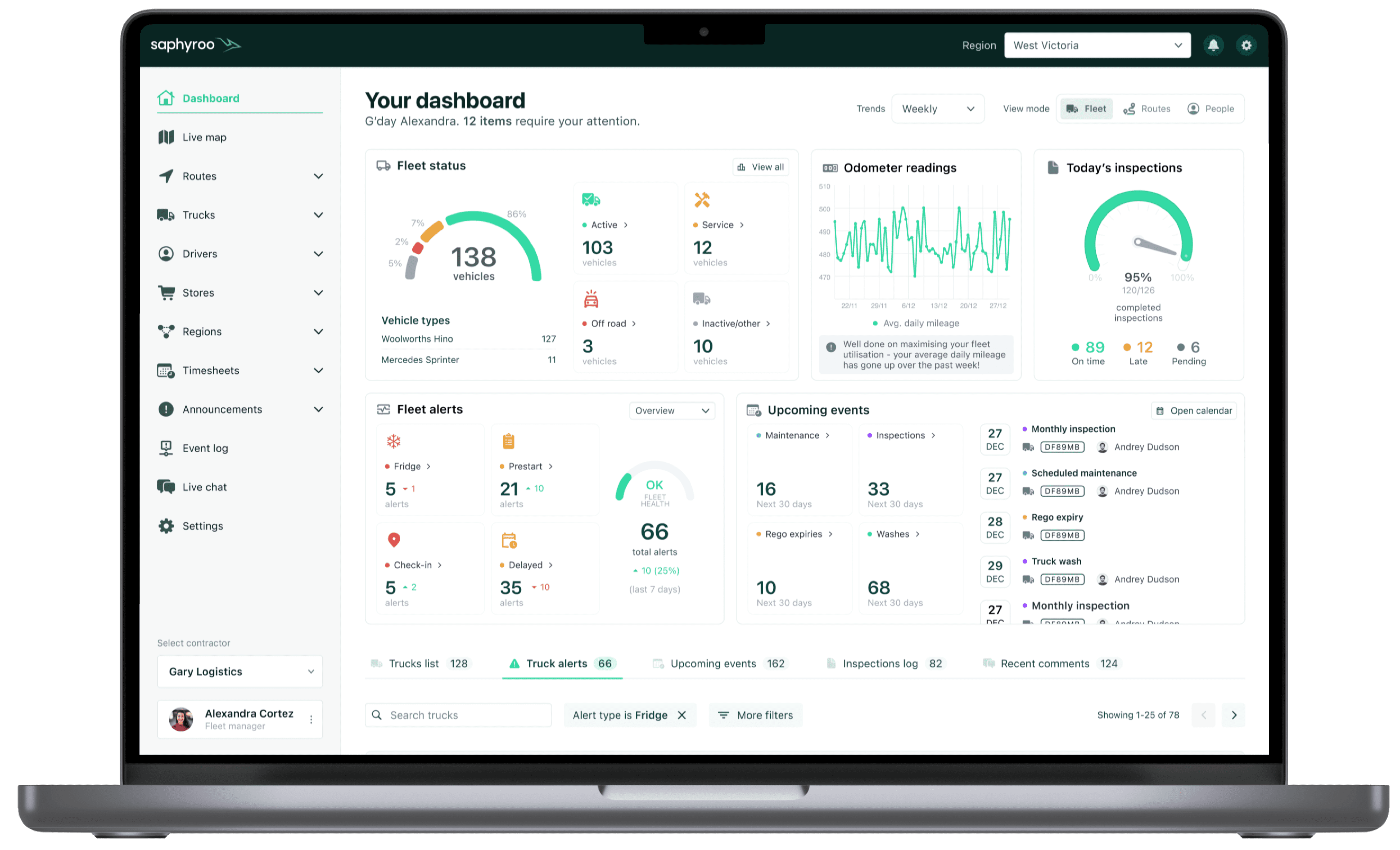
Saphyroo captures the operational evidence audits look for: including work diary records, fatigue checks, defect logs and sign off trails.
The Safety Management System, the decision between GSA and ACA and the policies underpinning compliance ultimately remain the responsibility of the operator.
If you want to understand how we structure compliance evidence ahead of the 1 August HVNL changes, this is where to start: