

If you run trucks in Saudi Arabia, three Transport General Authority rule changes hit your operation in 2026.
Miss the 27 August deadline and the fifth-offence fine for a foreign-registered truck reaches SAR 160,000, with vehicle impoundment and residency consequences stacked on top. Miss the 1 January National Address rule and every parcel without a valid address becomes a compliance breach at acceptance. Miss the April 2026 autonomous-vehicle framework and you are running AV pilots blind.
Most Saudi fleet managers are across one of the three. Almost none are across all three.
Here is the whole picture, every fine and the audit to close the gap before August.
The four systems you actually answer to
You don’t just answer to TGA. You answer to TGA, Wasl, MVPI and Muroor. They look interchangeable. They are not.
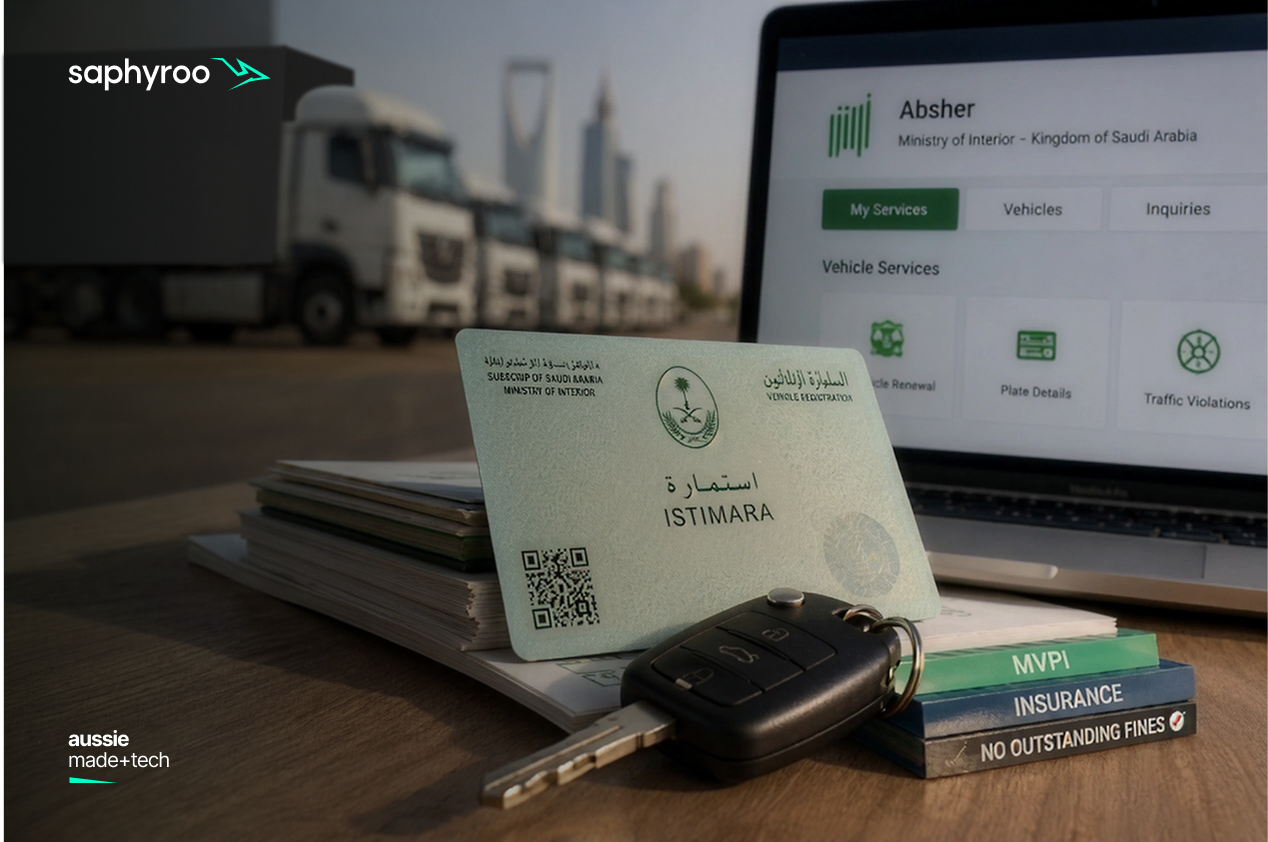
The Transport General Authority (TGA) is the sector regulator. It issues operator licences, sets rules, runs Wasl and imposes fines. Wasl (وصل), operated by Elm in partnership with TGA, is the mandatory registration and telemetry platform. Heavy commercial goods vehicles have been required to feed GPS and weight-sensor data to Wasl since April 2019. MVPI (Fahas) is the roadworthiness inspection programme run by the MVPI consortium. Vehicles pass MVPI; fleets don’t get MVPI-certified. The Traffic Department (Muroor, المرور) is the Ministry of Interior arm that enforces Rukhsa (driver licence) validity, Istimara (vehicle registration card) currency and the 24-point demerit system, with Saher providing automated capture.
The knock-on is what catches operators. An expired MVPI blocks Istimara renewal through Muroor. That expired MVPI is then material to a claim through the National Company for Unified Insurance (Najm). The exposure lands on your Wasl record. Your Wasl record feeds TGA operator-licence status. Audits find the chain, not individual links.
Wasl fields per vehicle include location, weight, driver identifiers (birth date, phone, licence number) and company details. A Wasl-ready GPS setup has to feed all of it reliably, not just location pings. If your weight sensor drops out for a week, that’s the gap an audit finds.
The 27 August 2026 deadline
Lexis confirmed on 8 April 2026 that TGA extended the deadline to 27 August 2026 for heavy and light freight operators. Three linked obligations sit inside that window: reclassify private-registered heavy vehicles as public transport, improve fleet utilisation within the authorised framework and ensure every driver holds the correct Professional Driver Card.
If your fleet is mixed private and commercial Istimara, run this audit now:
After August, based on TGA media centre communications and prior enforcement cycles, tolerance narrows. The tga.gov.sa Media Centre is the authoritative source; any movement on this timeline appears there first.
What non-compliance actually costs
The Saudi Press Agency publishes the numbers. They’re specific and ugly.
Wasl data-reporting gaps carry separate fines under TGA’s enforcement framework. They’re not published as a fixed schedule, but they are material. If you run a platform that flags missing Wasl fields before an audit does, these fines stop being a recurring line item.
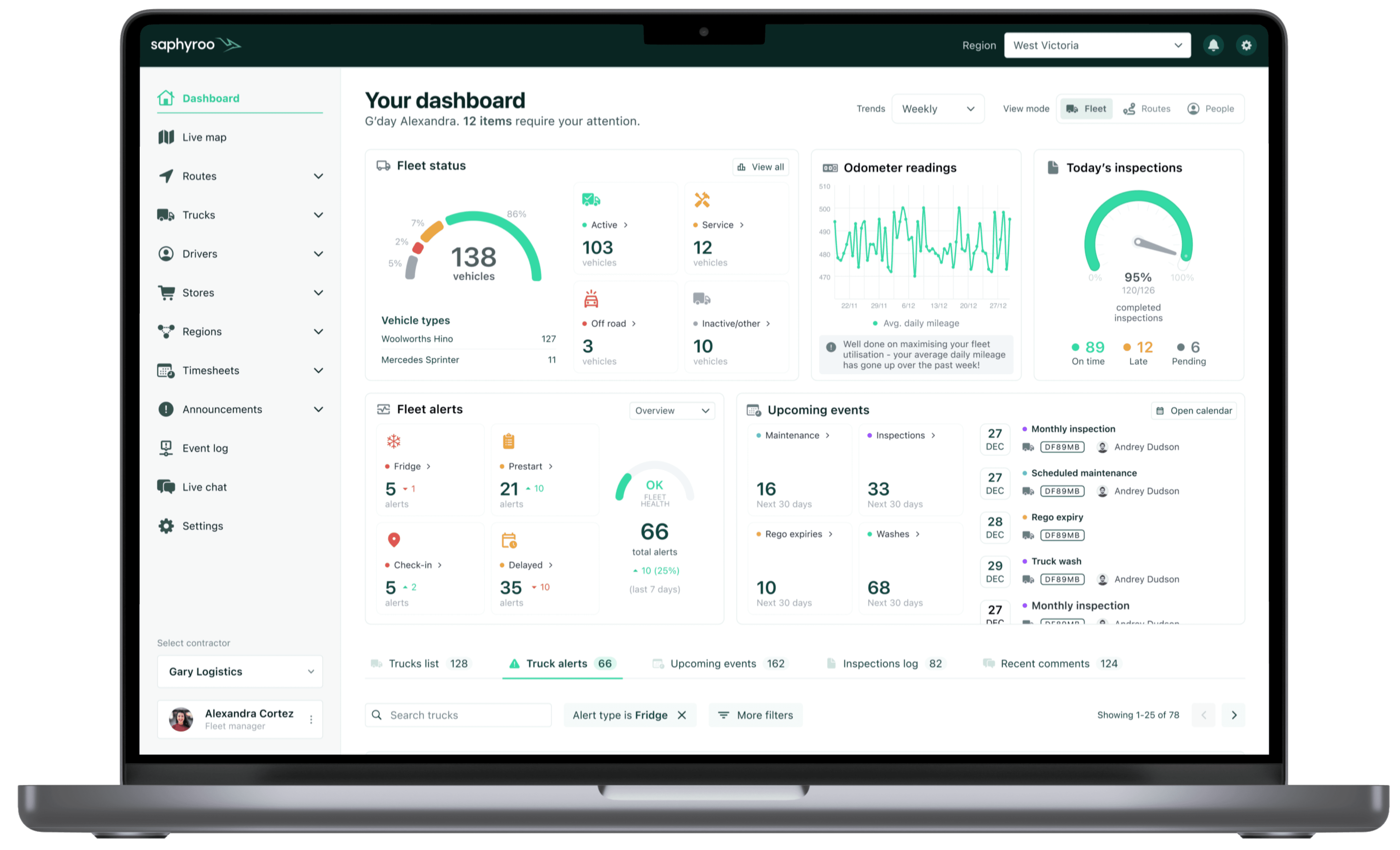
See how Saphyroo’s fleet management platform handles Wasl audit prep for Saudi operators through the August transition.
Operator licensing and driver cards
Naql is TGA’s single digital gateway, with seven sub-portals: Land Transport, Maritime Transport, Leasing Contracts, Ferries, Foreign Yachts, Cargo Documentation and City Entry. Goods operators work through Land Transport.
The licensing chain runs in order: Naql application, commercial registration (Ministry of Commerce), GOSI civil-responsibility certificate, labour-contract attestation, Wage Protection System compliance via Qiwa and Mudad, Nitaqat band confirmation, ZATCA clearance, Wasl link, Naql operation card per vehicle. A Nitaqat band in Low Green or Red will suspend TGA activity-licence processing. Operators entering the Kingdom underestimate this step consistently.
Professional Driver Cards come in four types via naql.sa:
Regulated activities include heavy commercial goods, all passenger transport categories (taxi, bus, limousine, school transport) and specialised or dangerous-goods work. Educational transport drivers must be 25 or older, hold first aid and pass a TGA medical. Reclassify the vehicles for August but leave the drivers on the wrong card type and you have not finished.
Saher (ساهر) feeds into all of this. Demerit accrual on a driver’s 24-point licence can affect card renewal eligibility. Driver-hours tracking that supports Wasl reporting builds the documentation trail that card applications and renewals ask for.
The 1 January 2026 National Address rule
From 1 January 2026, parcel delivery operators must reject any shipment without a valid National Address. TGA confirmed it in announcement 139. Saudi Gazette covered it in report 657494.
The National Address is a structured record (building number, street, district, city, postal code, additional number) plus a short code of four letters and four digits. Saudi Post (SPL) manages it. Addresses are accessible via Absher, Tawakkalna, Sehhaty and the SPL app. The rule covers courier parcels and B2B door-drops; port-to-port wholesale is out of scope.
If you are running last-mile delivery anywhere in the Kingdom, address validation is now a dispatch-acceptance step, not a logistics preference. Build a reject-on-missing-address branch at the door, not downstream.
April 2026 autonomous-vehicle framework
TGA issued the AV regulatory framework in April 2026. Testing, operation and data reporting for any AV pilot in commercial transport now sits inside it. Most Saudi fleets are not running AVs today. Data-reporting fields are likely to align with Wasl’s existing telemetry architecture as AV use cases emerge in the giga-project supply chain. Watch TGA media centre updates as the framework develops.
What to actually do before August
Four things, done by 1 August, get you through the window:
- Run the five-step reclassification audit above, every vehicle, every driver.
- Pull every driver’s Professional Driver Card status from naql.sa. Confirm the card type matches the activity.
- Verify Wasl is receiving location, weight and driver-identifier data for every vehicle, every day. Not weekly. Daily.
- Check your Nitaqat band forecast. If you’re drifting toward Low Green, fix it before the Naql chain flags it.
The August 2026 deadline isn’t the last of these. Vision 2030’s National Industrial Development and Logistics Programme is pushing a top-10 Logistics Performance Index position by 2030. Enterprise tenders and giga-project freight contracts are already rewarding operators with clean compliance records. Build the documentation trail now, or watch the contracts go to operators who already have it.
Frequently Asked Questions
What does TGA stand for in Saudi Arabia?
TGA is the Transport General Authority (الهيئة العامة للنقل). Established in 2012 as the Public Transport Authority, reconstituted as TGA in 2019 with a broader mandate across land, sea and rail. Sits under the Ministry of Transport and Logistic Services. Runs operator licensing, vehicle classification, the Wasl platform and enforcement.
Is Wasl the same as TGA?
No. TGA is the regulator. Wasl is TGA’s mandatory registration and telemetry platform, operated by Elm in partnership with TGA. Heavy commercial goods vehicles have been required to feed GPS and weight-sensor data to Wasl since April 2019. It’s a compliance requirement, not a certification or endorsement.
What are the worst TGA fines?
Foreign-truck unlicensed operation follows an escalating ladder: SAR 10,000 then 20,000 then 40,000 then 80,000 then 160,000, with residency consequences for expatriate operators. Repeat serious unlicensed transport tops out at SAR 20,000 plus 60-day impoundment. Baseline unlicensed passenger transport is SAR 5,000.
Who needs a Professional Driver Card?
Any driver in a regulated activity: heavy commercial goods, taxi, bus, limousine, school transport and specialised or dangerous-goods work. Four card types (Temporary, Seasonal, Annual, Restricted) via naql.sa. Educational transport adds extra conditions: age 25 or over, first-aid certificate, TGA medical.
Be ready before August
Saphyroo works with Saudi fleet operators from a Riyadh-based team, helping bring visibility to fleet data across TGA, Wasl, MVPI and Muroor systems. The aim is simple: issues get flagged early, not during audits.