UK Operator's Licence Guide: How to Apply in 2026
Applying for an O-Licence is straightforward. Getting it approved isn't always. This 2026 guide covers the three O-Licence categories, how Traffic Commissioners evaluate applications and the ongoing undertakings operators must comply with to remain licensed. Based on the latest official gov.uk guidance.
Ferhet Gurdezi11 MIN READ
Most O-licence applications that are refused fail for the same few reasons. One of the most common mistakes involves financial standing. Some applicants misunderstand financial standing and believe it is enough to show the required amount in their account temporarily. In practice, the Traffic Commissioner expects operators to demonstrate ongoing access to sufficient funds, usually assessed over a period of months.
Another frequent issue is placing the advert in the wrong newspaper or publishing it at the wrong time.
Problems can also arise when the nominated Transport Manager is already overseeing too many vehicles. The Senior Traffic Commissioner publishes guidance on how many vehicles one Transport Manager can realistically and effectively manage.
If you read through just a couple of months of Applications and Decisions for any traffic area, you will likely see the same mistakes coming up again and again.
Operating a goods vehicle over 3.5 tonnes MAM (Maximum Authorised Mass) on a public road without an operator’s licence is an offence under section 2 of the Goods Vehicles (Licensing of Operators) Act 1995. This applies whether the vehicle is being used for “own goods” or “hire and reward” work.
On conviction, the fine in England and Wales is unlimited under LASPO 2012, although in Scotland the maximum fine is £5,000. The vehicle can also be seized and impounded under the 2001 Enforcement Powers Regulations.
This guide covers where things commonly go wrong: both in getting an operator’s licence and in keeping it. All figures have been verified against GOV.UK as of 26 April 2026.
- Financial standing is not a single fee, it is money that must be kept available in the business bank account to show that the operator can run safely and legally. For a Standard licence, the requirement is £8,000 for the first vehicle and £4,500 for each additional vehicle. For a Restricted licence, it is £3,100 for the first vehicle and £1,700 for each additional vehicle.
- There are three types of licences: Restricted (carrying your own goods only), Standard National (UK hire and reward work, plus own account international transport) and Standard International (international hire and reward work, plus a UK Community Licence).
- Application fees are £257 to apply, £401 as a grant fee when the licence is issued, £401 every five years to renew, and £68 for an interim direction.
- Standard licences require a CPC-qualified Transport Manager and the hours they work should match the guidance in Annex A of Statutory Document 3.
- The published target time for a decision is around seven weeks. In practice, most straightforward applications take about nine to fourteen weeks. If there are objections or concerns about repute, this can extend beyond 21 weeks.
- Getting the licence is not the end of the process. Operators must continue to meet a number of legal undertakings covering areas such as vehicle maintenance, drivers’ hours, defect reporting and operating centre conditions. Failing to meet these obligations can lead to a Public Inquiry, where the Traffic Commissioner can issue warnings, suspend or revoke the licence and in serious cases disqualify directors or operators.
O-Licences Explained
An operator’s licence gives a business legal permission to use goods vehicles in Great Britain. In most cases, a licence is required when a vehicle has a MAM of more than 3.5 tonnes. This applies whether you are carrying your own goods or transporting goods for someone else.
The operator licensing system in Great Britain is set out in the Goods Vehicles (Licensing of Operators) Act 1995. Applications are handled by the Traffic Commissioner responsible for the area where the operating centre is based. Traffic Commissioners oversee the operator licensing system across the different Traffic Areas in Great Britain.
Businesses who build the right fleet system early, especially around vehicle maintenance, drivers’ hours and record keeping, usually find the application process much easier.
There is one important exception to the 3.5 tonne rule. Since 21 May 2022, some light goods vehicles between 2.5 and 3.5 tonnes MAM also require an operator’s licence when they are used for international hire and reward work. However, domestic van work within Great Britain using vehicles in this weight range does not normally require an operator’s licence.
Northern Ireland operates under a separate operator licensing system (2010 NI Act). It is administered by the Transport Regulation Unit within the Department for Infrastructure. Scotland remains part of the Great Britain operator licensing system, although it has its own Traffic Commissioner based in Edinburgh.
The Three Types of Operator’s Licence
Choosing the wrong type of operator’s licence can be expensive and time consuming. Changing licence types later usually means paying a £257 variation fee and waiting several more weeks for approval, so it is worth getting right from the start.
Restricted Licence
This licence allows a business to carry its own goods only. It does not require a Transport Manager and has the lowest financial standing requirement. This is usually the right option for businesses such as builders, manufacturers or utility companies transporting their own equipment or materials. However, it becomes unsuitable as soon as the business starts carrying goods for other people in return for payment.
Standard National Licence
This licence allows hire and reward work within the UK, as well as transporting your own goods both in the UK and internationally. This type of licence requires a qualified Transport Manager and is the one most UK haulage operators use.
Standard International Licence
This licence allows hire and reward transport outside the UK. It is issued alongside a UK Licence for the Community for journeys into EU member states. Different arrangements apply for countries such as Iceland, Liechtenstein, Norway and Switzerland and some international routes may also require ECMT permits.
If there is a realistic chance the business will start international hire and reward work within the next year, applying for a Standard International licence from the beginning is often the better option. It can avoid the extra variation fee and delays involved in upgrading the licence later.
What Financial Standing Really Means
Financial standing is not a fee or a one off payment. It is money that must be available in the business bank account and kept in place before you apply and maintained for as long as you hold the licence.
Financial Standing: GOV.UK Operator Licensing Guide
| Licence type | First vehicle | Each additional vehicle |
|---|---|---|
| Restricted | £3,100 | £1,700 |
| Standard National | £8,000 | £4,500 |
| Standard International (HGV) | £8,000 | £4,500 |
| Standard International (LGV, 2.5-3.5t) | £1,600 | £800 |
These figures are set in euros under assimilated Regulation (EC) 1071/2009 and are converted into sterling annually. Always check the latest amounts on the gov.uk operator licensing guide before applying.
Statutory Document 2 (Finance) sets out how the Traffic Commissioner assesses financial standing. The requirement is based on the average level of available funds over the previous three months, supported by evidence such as bank statements, audited accounts an agreed overdraft facility or confirmed invoice finance.
Simply putting £8,000 into the account shortly before applying is not enough on its own. The Traffic Commissioner needs to see that the money has been consistently available over time, not temporarily added just before the application or bank statements are produced. This is a common reason why applications are refused.
Transport Managers and Working Hours
A Transport Manager is required for both Standard National and Standard International licences. However, restricted licence holders do not need a Transport Manager.
The Transport Manager must hold a Certificate of Professional Competence (Operator CPC, not Driver CPC), be of good repute (meaning they are considered a fit and proper person to run transport operations safely and legally) and be professionally competent. In most cases they must also be based in the UK.
The qualification can be gained through four ways: the OCR exam, the CILT exam, an Acquired Rights certificate or in some cases by converting an EU issued CPC. One area most application checklists overlook is working hours.
Indicative TM Hours, Annex A of Statutory Document 3
| Fleet size (vehicles) | Hours per week (starting point) |
|---|---|
| 2 or fewer | 2-4 |
| 3-5 | 4-8 |
| 6-10 | 8-12 |
| 11-14 | 12-20 |
| 15-29 | 20-30 |
| 30-50 | 30 to full time |
| 50+ | Full time plus assistance |
These figures are starting points, not fixed limits. The Traffic Commissioner can require a Transport Manager to provide more time if the operation is complex or has higher levels of activity, such as frequent driver changes.
Under Statutory Document 3, an external Transport Manager is normally limited to a maximum of four operators or a combined total of 50 vehicles. A Transport Manager who is already responsible for multiple small fleets is a common issue that can lead to a Public Inquiry.
The Operating Centre and Advertising Rules
An operating centre must have suitable off street parking, safe access and enough capacity so that its use does not cause unacceptable levels of noise, traffic disruption or environmental impact.
Section 11 of the Goods Vehicles (Licensing of Operators) Act 1995 requires applicants to advertise their application in an approved local newspaper within a 42 day window (21 days before and 21 days after the date the application is submitted).
If the advert appears in a newspaper that is not on the Traffic Commissioner’s approved list or outside this time window, the application will be refused. People who live or work near the proposed operating centre then have 21 days from the date of the advert to make representations.
Statutory objections are separate and come from a defined list under section 12, including the police, local authorities, planning authorities and certain trade unions or trade associations.
Good reputation is the third key part of the application, where applicants must disclose relevant motoring, financial and employment related matters from the past five years. If a conviction or issue is not declared and is later discovered through DVSA records, it can itself raise concerns about the operator’s reputation.
The O-Licence Application Process
Each step depends on the one before it. Securing an operating centre before you have a Transport Manager nominated is fine. Building three months of bank statements before you know the financial standing threshold for your fleet size is not.
1
Decide the licence type, including whether the Standard International LGV option applies if any 2.5–3.5t vehicles will be used for international work.
2
For Standard licences, appoint a CPC qualified Transport Manager. Their working hours must align with the indicative scale in Annex A and the arrangement should be confirmed in writing.
3
Secure an operating centre with appropriate planning permission for HGV use and sufficient off street parking for all vehicles you intend to authorise.
4
Prepare your financial standing evidence. This usually means three months of bank statements showing an average balance above the required threshold for your licence type and fleet size.
5
Advertise the application in an approved local newspaper within the 42 day window.
6
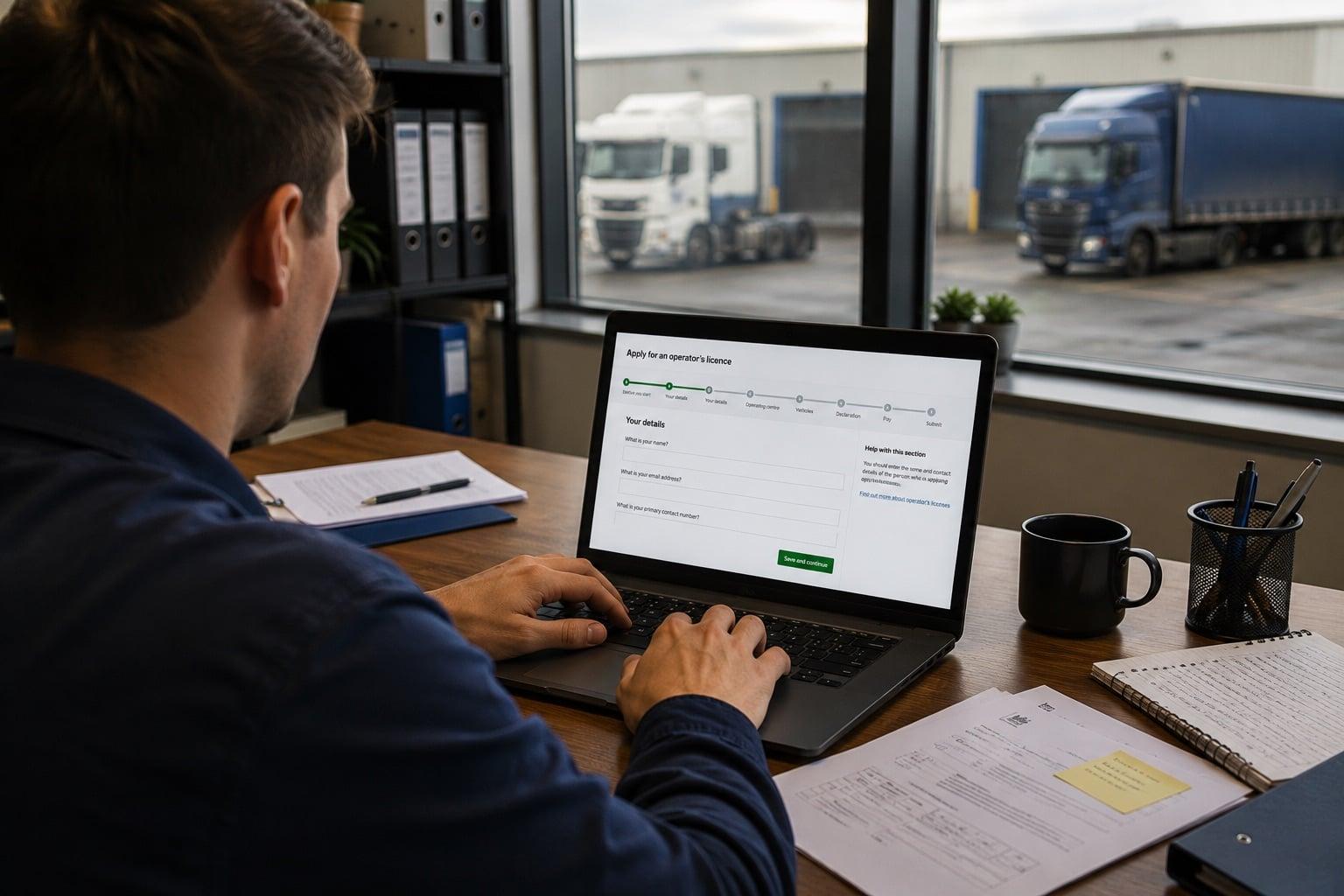
Submit the application via the Vehicle Operator Licensing (VOL) service on gov.uk. The paper form (GV79) is still accepted in limited cases.
7
Pay the £257 application fee at the point of submission.
8
Wait for the Traffic Commissioner’s decision. The target service time is seven weeks, although most straightforward applications take around nine to fourteen weeks.
9
If granted, pay the £401 issue fee. The licence then runs on a five year continuation cycle (£401 each time). The operator’s disc must be displayed on every authorised vehicle from the start.
If you cannot wait for the full application to be decided, you can apply for an interim direction under section 24 of the Goods Vehicles (Licensing of Operators) Act 1995. The application fee for an interim direction is £68 and this gives temporary permission to operate while the Traffic Commissioner considers the main application.
Interim directions are commonly used during business purchases, fleet expansions or when replacing a Transport Manager. However, operators still need to meet the full financial standing requirements before temporary authority will be granted.
Keeping Your Operator’s Licence
Many operators focus on obtaining their O-Licence, the bigger challenge is keeping it. Once granted, an O-Licence comes with a number of legal undertakings that operators must continue to meet throughout the life of the licence.
These undertakings include:
- Keeping vehicles and trailers safe, roadworthy and properly maintained.
- Making sure drivers report defects before and after journeys.
- Repairing safety related defects before the vehicle is used again.
- Keeping records of inspections, defects, repairs and producing them if requested.
- Ensuring drivers follow the rules on drivers’ hours and tachographs, which are devices that record driving time, speed, distance travelled and rest periods.
- Using the operating centre only in the way authorised on the licence.
Alongside these undertakings is the Operator Compliance Risk Score (OCRS), a DVSA rating system that grades operators as green, amber or red based on roadside inspections, prohibitions and annual test results.
Achieving a green rating depends on consistently following the licence undertakings in day to day operations, not simply having them written down in a policy document. The detail behind these requirements sits in our drivers’ hours summary and tachograph download cycles for UK operators.
When a Public Inquiry letter arrives, the issue is rarely whether the records exist somewhere within the business. What matters is whether the operator can produce them quickly within the time frame set by the Traffic Commissioner. Saphyroo helps UK operators keep PMI scheduling and tachograph downloads in a single audit trail, so the evidence is ready when the request comes.
What to Expect at Public Inquiries
The reasons an operator is called to a Public Inquiry are often fairly consistent. They can include repeated roadside prohibitions, a pattern of drivers’ hours or tachograph infringements, breaches of operating centre conditions or concerns about a transport manager’s good reputation.
The possible outcomes vary widely. The Traffic Commissioner may decide to take no action, issue a formal warning, attach additional conditions to the licence, reduce the number of authorised vehicles, suspend the licence, revoke it completely, disqualify the operator and directors under section 28 of the Goods Vehicles (Licensing of Operators) Act 1995 or find that a Transport Manager is no longer of good repute under Schedule 3.
A written decision is usually issued a few weeks after the inquiry. From the date on that decision, the operator has one month to appeal to the Upper Tribunal. This deadline is strict and runs only from the date shown on the decision, not from the hearing date or when the letter is received. Once that month has passed, the right of appeal is lost.
Getting a licence is not where the Traffic Commissioner’s scrutiny ends, but where it begins. Before applying, it is worth reviewing recent Applications and Decisions in your traffic area to understand how similar cases are assessed.
You should also make sure you have at least three months of bank statements showing the required financial standing and that your Transport Manager’s expected hours are agreed in writing with reference to Annex A. The underlying regulatory standards have remained largely stable for years, but the amount of evidence now expected to demonstrate compliance has steadily increased.
See how Saphyroo helps UK operators surface the evidence Traffic Commissioners ask for →