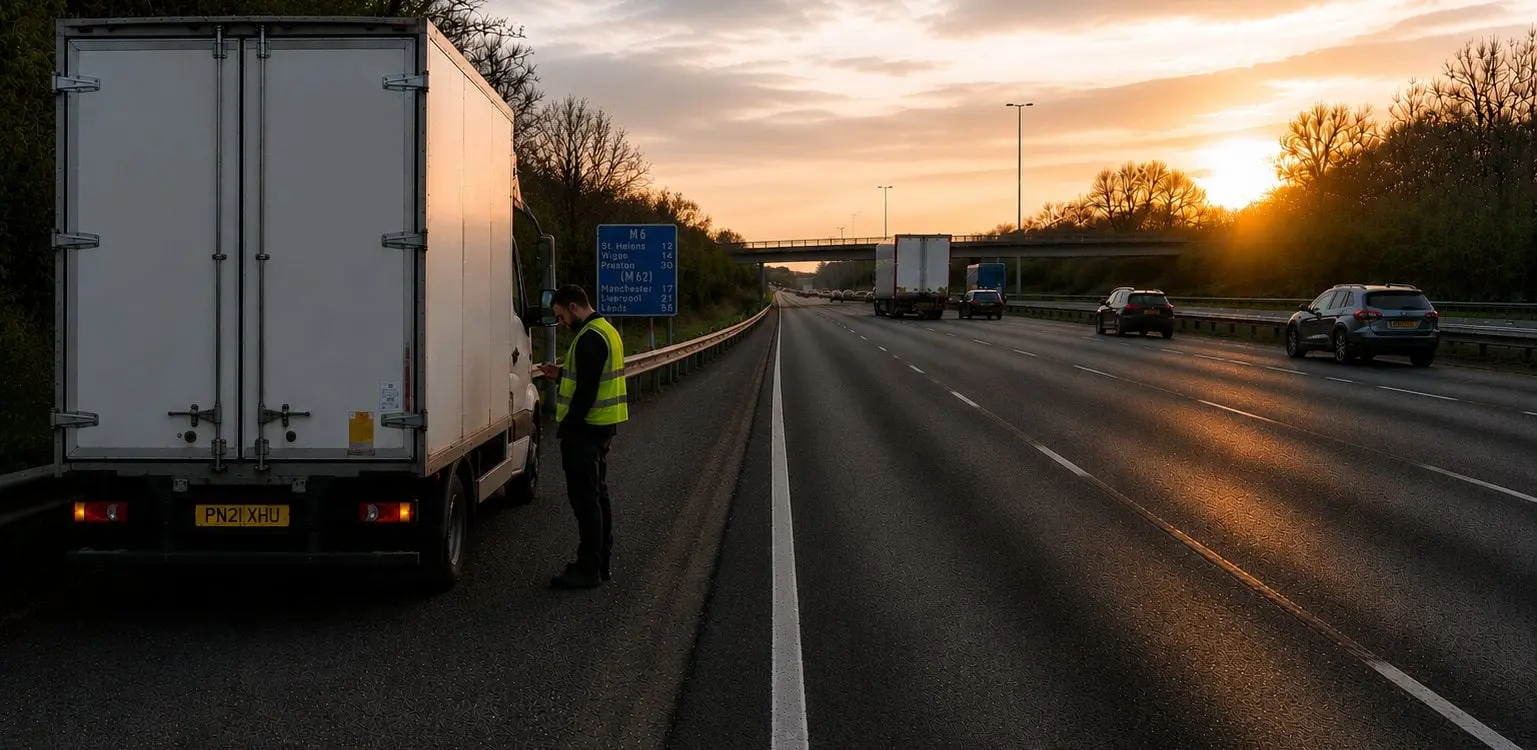
DVSA Roadside Checks: What Gets You Stopped and How to Avoid It
A DVSA roadside check might seem random, but it rarely is. What officers check, how OCRS affects selection, what a stop can cost and how to prepare your fleet.

A DVSA roadside check might seem random, but it rarely is. Behind the scenes, the DVSA uses a risk based approach, considering factors such as vehicle condition, compliance history and your Operator Compliance Risk Score (OCRS) when deciding which vehicles to inspect.
A roadside check can mean far more than a fixed penalty. Serious defects can lead to prohibitions, affect your OCRS and in the most serious cases, put your operator's licence at risk. Yet many roadside failures are preventable: a lot of the defects found at the roadside are ones a driver could have spotted during the daily walkaround check.
This guide explains what DVSA officers check, why vehicles are selected and how operators can reduce the risk of roadside enforcement action. It covers Great Britain (England, Scotland and Wales); Northern Ireland is regulated separately by the DVA.
At a Glance
- Most DVSA roadside checks are risk targeted. Your OCRS influences how often your vehicles are selected, making compliance your first line of defence.
- Many roadside defects could have been spotted during a driver's daily walkaround check, and DVSA treats an obvious one as a sign of weak maintenance.
- One stop can lead to multiple fines. Fixed penalty notices are issued per offence, with fines of up to £300 for each offence.
- You have 28 days to respond. Pay the fixed penalty or request a court hearing. Ignoring it increases the penalty by 50%.
- An 'S' marked prohibition is serious. It can raise concerns about your maintenance systems and may trigger action by the Traffic Commissioner.
- OCRS is based on a rolling three year record. Recent offences have the greatest impact, while older issues gradually lose influence.
What DVSA Checks at the Roadside
DVSA officers work through four main areas during a roadside inspection:
- Vehicle roadworthiness and mechanical condition
- Tachograph and drivers' hours records
- Vehicle weight and load security
- Driver licensing, including vocational entitlement, the Driver CPC and Driver Qualification Card (DQC)
What commonly causes a failure
| What the officer checks | What usually trips it up |
|---|---|
| Roadworthiness | Tyres, brakes, lights or tampered emissions systems |
| Tachograph | Missing or incorrect drivers' hours records |
| Weight and load | Axle overload or insecure loads |
| Driver licensing | Incorrect licence category, expired entitlement or no valid DQC |
Drivers' hours are checked directly from the tachograph against the legal requirements. Vehicle emissions tampering, including removed diesel particulate filters (DPFs) and AdBlue defeat devices, is also a focus of roadside enforcement. Operators can be given 10 days to rectify these issues before the vehicle is prevented from continuing in use.
Roadworthiness remains one of the most common reasons vehicles fail roadside inspections. Worn tyres, faulty lights and brake defects often develop gradually, making regular walkaround checks and planned maintenance the best way to prevent them.
Why DVSA Stopped You
A uniformed DVSA authorised stopping officer or a police constable can require you to stop and failing to comply is an offence.
Roadside inspections are often supported by Automatic Number Plate Recognition (ANPR), which reads vehicle registration plates and helps officers identify commercial vehicles for inspection. Once directed into a check site, your vehicle may be inspected by DVSA alone or alongside other enforcement agencies.
Roadside check sites are commonly shared with the police, HMRC and Border Force, depending on the location and type of operation. Inspections can take place at dedicated enforcement sites, service areas or roadside lay bys.
DVSA's roadside enforcement focuses on commercial vehicles and their operators rather than private cars.
OCRS Explained
Your Operator Compliance Risk Score (OCRS) sits at operator level and is linked to your O licence rather than an individual vehicle. It is one of the main factors DVSA uses when deciding how frequently to inspect an operator's vehicles.
DVSA measures two areas of compliance:
- Roadworthiness: vehicle condition, annual test results and roadworthiness prohibitions.
- Traffic: drivers' hours, tachograph compliance and weight related offences.
Your OCRS is based on the number and seriousness of offences and defects recorded during DVSA encounters over a rolling three year period. More serious defects score more heavily, and recent issues carry greater weight than older ones.
Operators are placed into OCRS bands:
- Green: lower risk
- Amber: medium risk
- Red: higher risk
- Grey: insufficient DVSA history
- Blue: DVSA Earned Recognition operators
A higher OCRS increases the likelihood of roadside inspections, although it is not the only factor DVSA considers. Operators can view their own OCRS through DVSA's operator self service, but the score is not available for other businesses to see.
OCRS applies to HGV and PSV operators, as well as certain 2.5 to 3.5 tonne vans used for international hire or reward work, since May 2022. Domestic light vans can still be stopped and inspected but are not assessed under OCRS in the same way.
Drive360
Keep every record an auditor asks for
Licences, inspections, defects and reports for every driver and vehicle, filtered and exported in a few clicks.
What a Roadside Check Can Cost
Graduated fixed penalties range from £50 to £300, depending on the seriousness of the offence.
Graduated fixed penalties
| Offence | Threshold | Fixed penalty |
|---|---|---|
| Exceeding a driving limit | Less than 1 hour over | £100 |
| Exceeding a driving limit | 1 to 2 hours over | £200 |
| Exceeding a driving limit | 2 hours or more over | £300 |
| Excess weight | Less than 10% over | £100 |
| Excess weight | 10% to 15% over | £200 |
| Excess weight | 15% or more over | £300 |
| Defective brakes | Flat rate | £100 and 3 penalty points |
A traffic examiner and a vehicle examiner can each issue up to five fixed penalty notices during the same inspection. This means a single roadside check can result in multiple penalties, with DVSA's guidance saying up to 10 is possible from a single check.
More serious offences, including significant overloads and the most severe drivers' hours breaches, may be referred directly to court instead of receiving a fixed penalty.
Drivers without a UK address are normally required to pay a financial penalty deposit at the roadside. This is held against the penalty rather than added to it. Court route deposits can be up to £500 per offence, subject to a £1,500 maximum. Failure to pay can result in the vehicle being immobilised.
Once a fixed penalty has been issued, you have 28 days to pay or request a court hearing. If you believe the notice was issued incorrectly, you have 10 days to make a complaint to DVSA. If no action is taken, the penalty increases by 50%.
When DVSA Can Stop Your Vehicle Moving
If a defect is serious enough, DVSA can issue a prohibition, preventing the vehicle from being driven until the issue is resolved. Prohibitions are not limited to mechanical defects. They can also be issued for overloading or drivers' hours offences, which may prevent the driver from continuing until they have taken the required rest.
There are two types of prohibition:
- Immediate: the vehicle cannot continue until the defect has been rectified.
- Delayed: the vehicle can continue operating for a limited period, usually up to 10 days, before repairs must be completed.
The most serious is an "S" marked prohibition. This indicates that DVSA believes the defect reflects a failure in the operator's maintenance system rather than an isolated fault. An immediate S marked prohibition can lead to vehicle immobilisation, prosecution and a DVSA investigation into the operator's maintenance procedures. It is a judgement on the operator's compliance systems, not just the condition of one vehicle.
How a Roadside Check Can Affect Your O Licence
A roadside inspection does not always end with a fixed penalty. Serious outcomes, including an S marked prohibition, maintenance failures or certain convictions, can be reported to the Traffic Commissioner.
Depending on the circumstances, this may lead to a public inquiry, where the operator's licence, the transport manager's reputation and their Certificate of Professional Competence (CPC) may all be reviewed.
It is important not to confuse OCRS with a Public Inquiry. OCRS influences how often your vehicles are selected for roadside inspection. A Public Inquiry is triggered by serious compliance concerns identified by DVSA, not by your OCRS band itself.
Operators with consistently strong compliance records may also be eligible for DVSA Earned Recognition. The voluntary scheme is open to operators that meet DVSA's eligibility requirements and use a DVSA validated IT system to submit performance data. Earned Recognition operators receive a blue OCRS band and are less likely to be stopped for routine roadside inspections.
Saphyroo is not a DVSA approved Earned Recognition system. However, Drive360 helps operators maintain accurate maintenance, walkaround and compliance records, supporting a more organised and audit ready compliance process.
How to Prepare For a DVSA Roadside Check
Most of what fails a roadside check was preventable before the vehicle left the depot, and many defects are ones a driver could have spotted during the daily walkaround check.
Good preparation starts with a few basics:
- Complete a proper daily walkaround check and record it. A signature alone is not evidence that checks have been completed properly. Drive360 digitises walkaround checks, captures defects with supporting photos and tracks defect rectification against maintenance records. This creates a clear audit trail whenever evidence of compliance is needed.
- Identify, fix and close out defects before the vehicle is dispatched, with a clear dated record.
- Keep driver card downloads within the required 28 day period and vehicle unit downloads within the required 90 day period.
- Make sure drivers have access to the current day's tachograph records and the previous 28 days of records when required. This is separate from the operator's responsibility for downloading and retaining tachograph data.
- Understand your OCRS band and address any issues affecting your compliance score.
Driver preparation matters as much as operator preparation. When directed into a check site, drivers should stop promptly, be cooperative with the examining officer and have their driver card, licence and any required records immediately accessible. Officers can require the production of tachograph records for the current day and the previous 28 days. Having those ready avoids delays and signals an organised operation. Drivers should answer questions honestly but are not required to sign anything they disagree with at the roadside. If a prohibition is issued, the driver should not attempt to move the vehicle until the officer confirms it is clear to do so. A driver who understands the process is less likely to make a minor check worse through confusion or an unhelpful response.
FAQs
Can DVSA stop any vehicle?
DVSA primarily targets commercial vehicles, including HGVs, PSVs and certain vans. A uniformed DVSA authorised stopping officer or a police constable can require a vehicle to stop. Private cars are not normally the focus of DVSA roadside inspections.
How long can DVSA prohibit my vehicle?
A vehicle can be prohibited immediately if a serious defect makes it unsafe to continue, meaning it cannot return to the road until the issue is resolved. For some defects, DVSA may allow a delayed prohibition period of up to 10 days, depending on the severity of the issue.
How do I check my OCRS score?
You can check your OCRS through DVSA's operator self service. Your business can view its own score, but OCRS information is not available for the public to view.
Fewer Roadside Problems Start With Better Compliance Records
Roadside inspections are part of operating a commercial fleet. Failing them doesn't have to be.
Find out how Drive360 keeps your compliance records organised and ready for inspection
Sources, checked 9 Nov 2026
Built for UK operator compliance.
Contractors running their fleets on Saphyroo scored 100% in a tier-one carrier's compliance audit. Walkaround checks and drivers' hours in one place, ready when DVSA asks.
Book a demoSee pricing